AI Henna Design Generator
It Draws the Hand Right. It Drifts on the Repeat.
Six mehndi styles — Indian bridal, Arabic floral trail, mandala medallion, repeat border strip, minimal fine-line and Moroccan geometric. This ai henna design generator is free, needs no account and adds no watermark. It makes design sheets to trace from rather than stencils to fill in, and the gallery below shows, at full zoom, exactly why.
Try the AI Henna Design Generator — Free
Pick a mehndi style, generate a square design sheet, then print it and trace from it
AI Henna Design Generator
Choose one of the six mehndi styles below and generate. Each one is a complete design on its own, so there is nothing you have to type — but the box underneath will take a line if you want a particular name, motif or occasion. One thing to know before you start: four of these six presets render as flat reference sheets on paper rather than photographs on skin. That is deliberate. This model draws hands beautifully and drifts on anything it has to repeat, so the reliable workflow is to let it design the motif and to let your own cone supply the repetition.
Every preset returns a square 1:1 design. Print it and trace from it rather than treating it as a stencil — the gallery below is the full argument for why that step is yours and not the model’s.
AI Henna Design Generator Examples
Six squares exactly as they came back — count the fingers, then compare the motifs
The Hand Is Perfect. The Four Fingers Do Not Match Each Other.
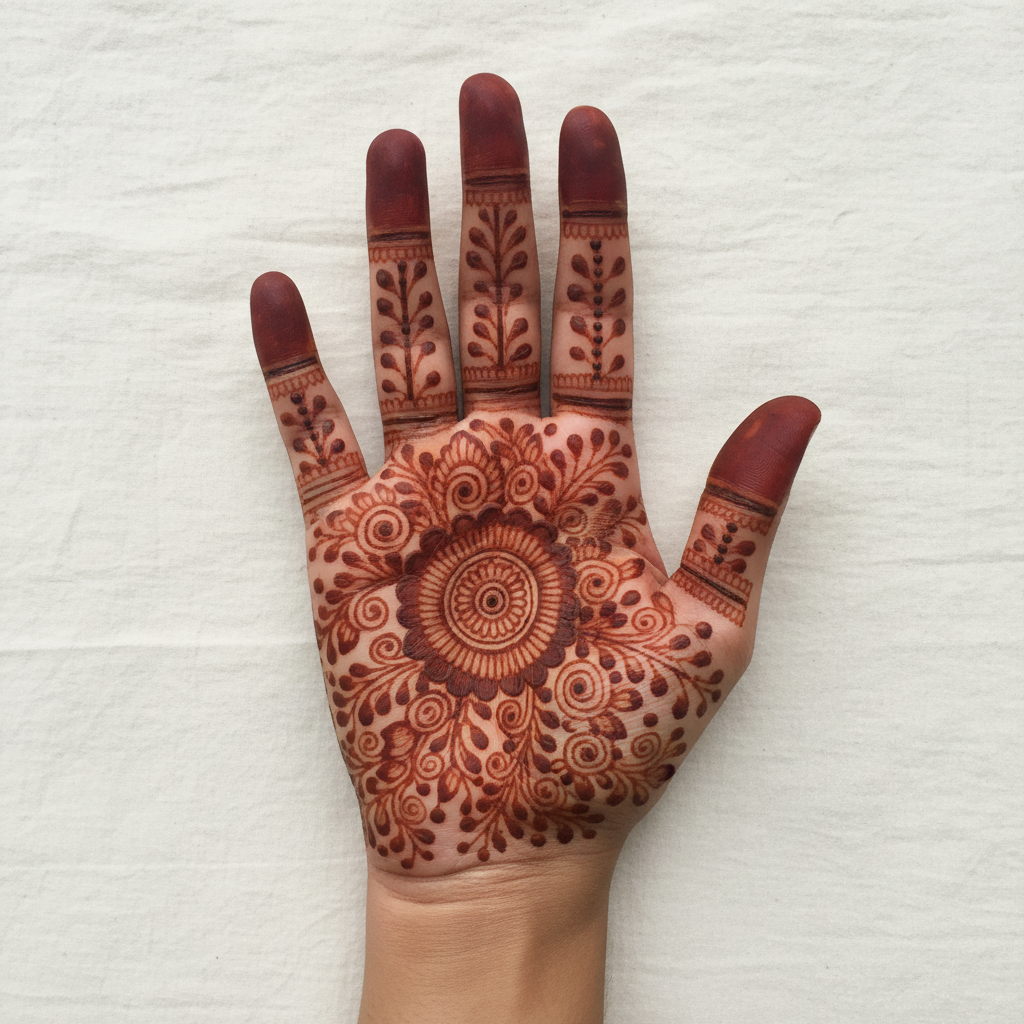
Start here, because it inverts the thing everybody expects. This is a left hand lying palm up: one thumb, four fingers, each one separated by a visible gap of cloth, every fingertip inside the frame, correct relative lengths, correct proportions. The stain is a believable dried reddish brown with soft edges, the fingertips are dipped solid the way real bridal work is done, and the palm medallion is a clean concentric rosette that a human artist would be happy to have piped. Now look along the fingers, which is where the brief actually was. The instruction was one narrow band of small repeating dots around each finger. What came back is four different fills: two leafy vines with different leaf counts, one plain column of dots, and one short dot-and-leaf sprig. Zoom into the ring finger vine and the leaves on the left of the stem are visibly fatter and fewer than the ones on the right — a vine that is not symmetrical about its own stem. The anatomy is flawless. The repetition is freehand.
Eight Asked For, Eight Delivered, and They Genuinely Match
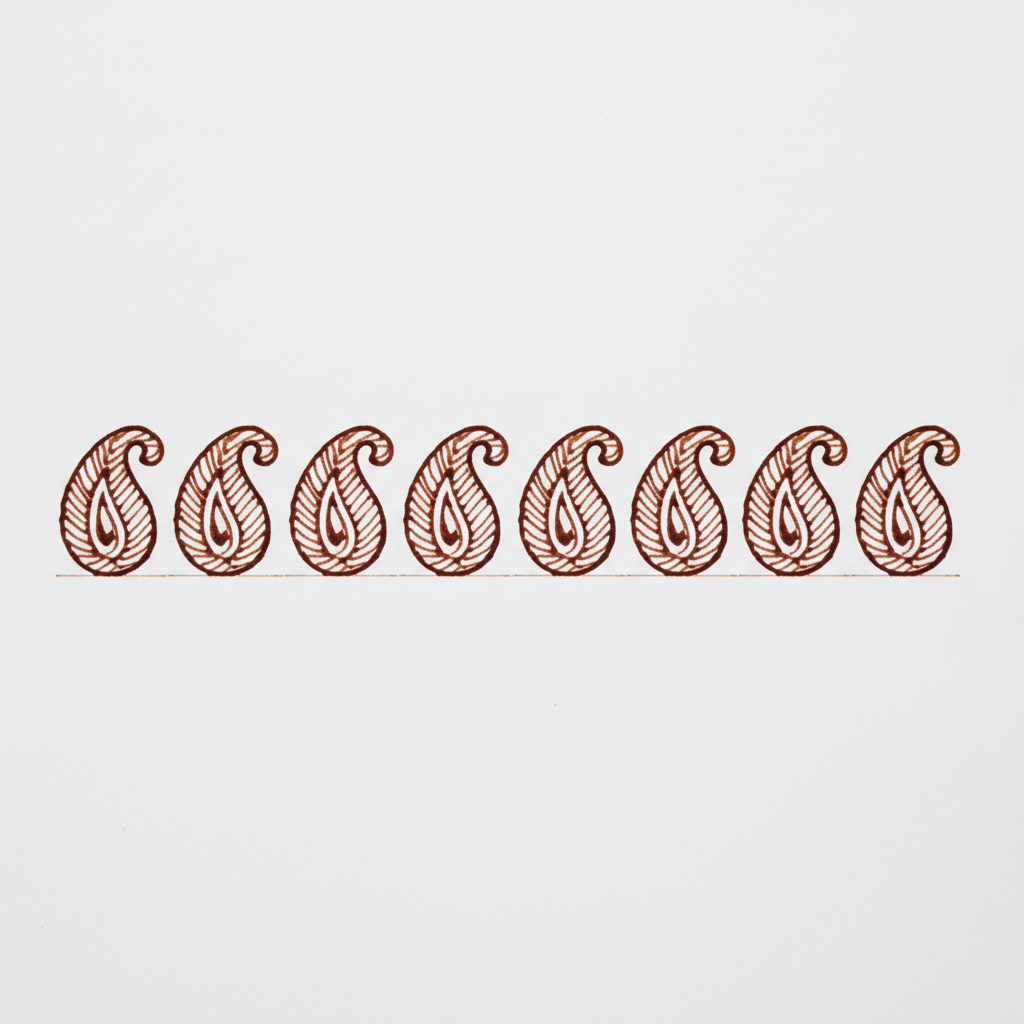
This is the best render of the six and the one that decides what the presets on this page look like. The instruction was exactly eight paisley mango motifs, identical in size, identical in shape, identical in their internal filling, all leaning the same way, all on one shared baseline with equal gaps. Count them: eight. Then compare them at full zoom, which is the part that matters. Same hook curl, same outer teardrop, same inner teardrop, same fine parallel hatching, same little crosshatched skirt sitting on the rule. The differences you can find are the differences you would find in hand-piped work: the third motif has a slightly fatter inner drop, the eighth a slightly bigger curl. As a border strip to trace onto a wrist cuff or an ankle band, this is finished. Hold onto it, because the next three images explain why this one worked.
Eight Petals, Correctly Counted, in Three Different Shapes
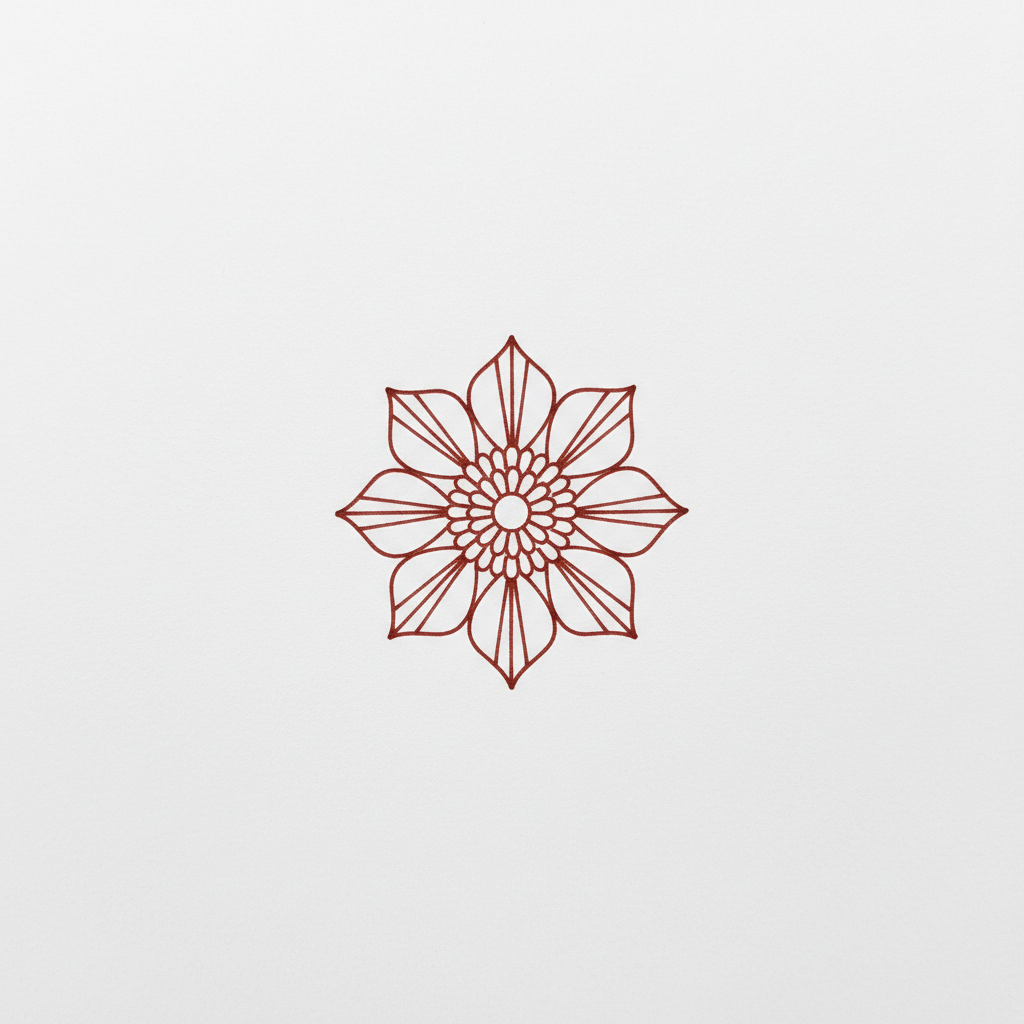
The brief was one circular medallion with exactly eight petals, and the eight petals identical to each other: same length, same width, same pointed tip, same internal pattern of three fine lines. It got the hard-sounding part right. There are eight petals, and each one carries exactly three fine internal lines. What it did not do is make them the same petal. North and south are tall pointed ogees. East and west are flatter horizontal lozenges. The four diagonals are broad rounded leaves. Three distinct shapes arranged in a perfectly regular four-fold pattern — which is, to be fair, a handsome medallion, and the overall symmetry is better than anything else on the sheet. It simply is not the one repeated petal that was asked for. Note also the centre: the instruction was one small solid dot ringed by fine dots, and what arrived is an empty white circle inside two rings of petal scales.
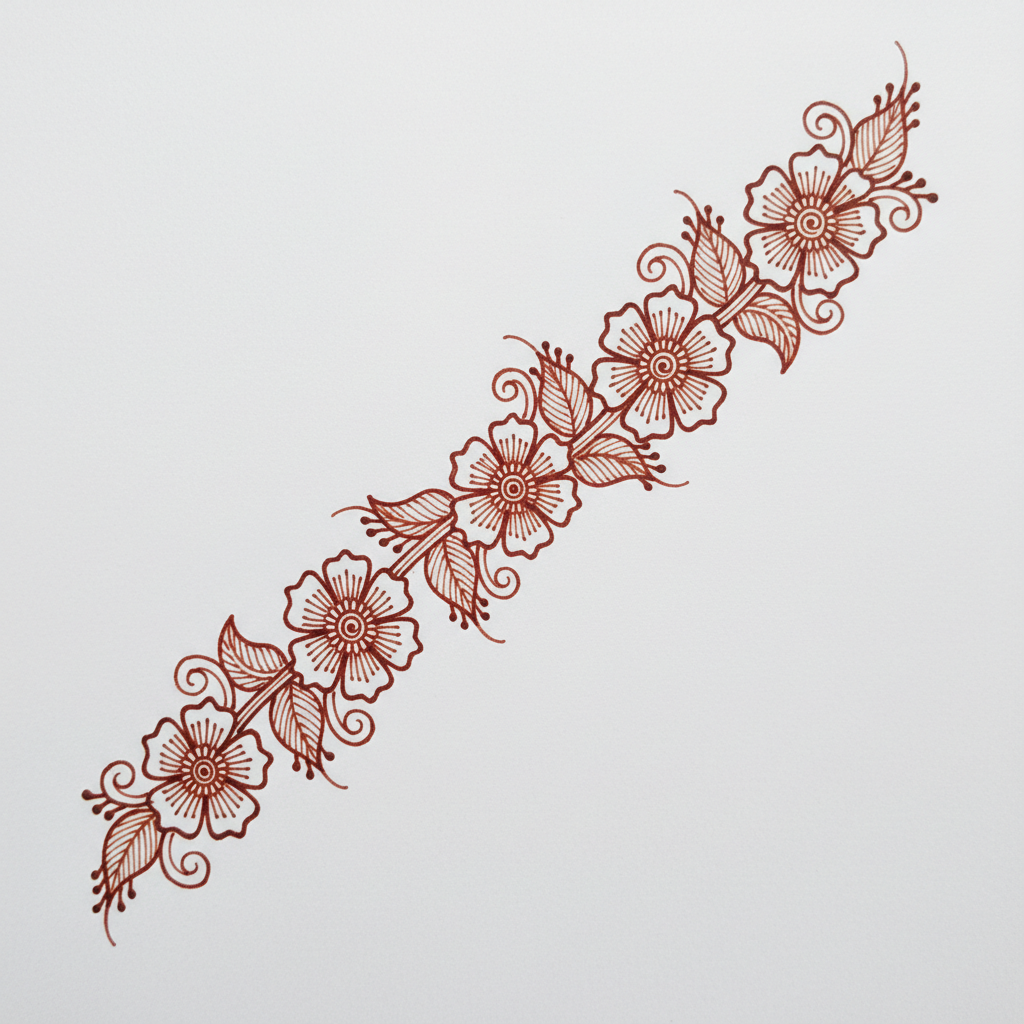
It Counted the Flowers and Miscounted the Petals Inside Them
Line quality first, because this is the prettiest drawing of the six: one continuous vine running corner to corner, spiral centres inside dotted rings, radiating stamen lines, leaves veined with fine parallel hatching, curling tendrils breaking off between the blooms. Any mehndi artist would trace this. The brief asked for five large open flowers spaced evenly along the trail, and there are exactly five, evenly spaced. Then count the petals on any one of them: six, not the five specified, and six on every single flower — so it held the count it invented perfectly while missing the count it was given. The other ignored instruction is about medium rather than arithmetic. It was told clean flat line work with solid filled petals, no shading. Every petal came back outlined and hollow with fine radiating line-fill instead, and the plain white paper came back a soft grey with a vignette in the corners.
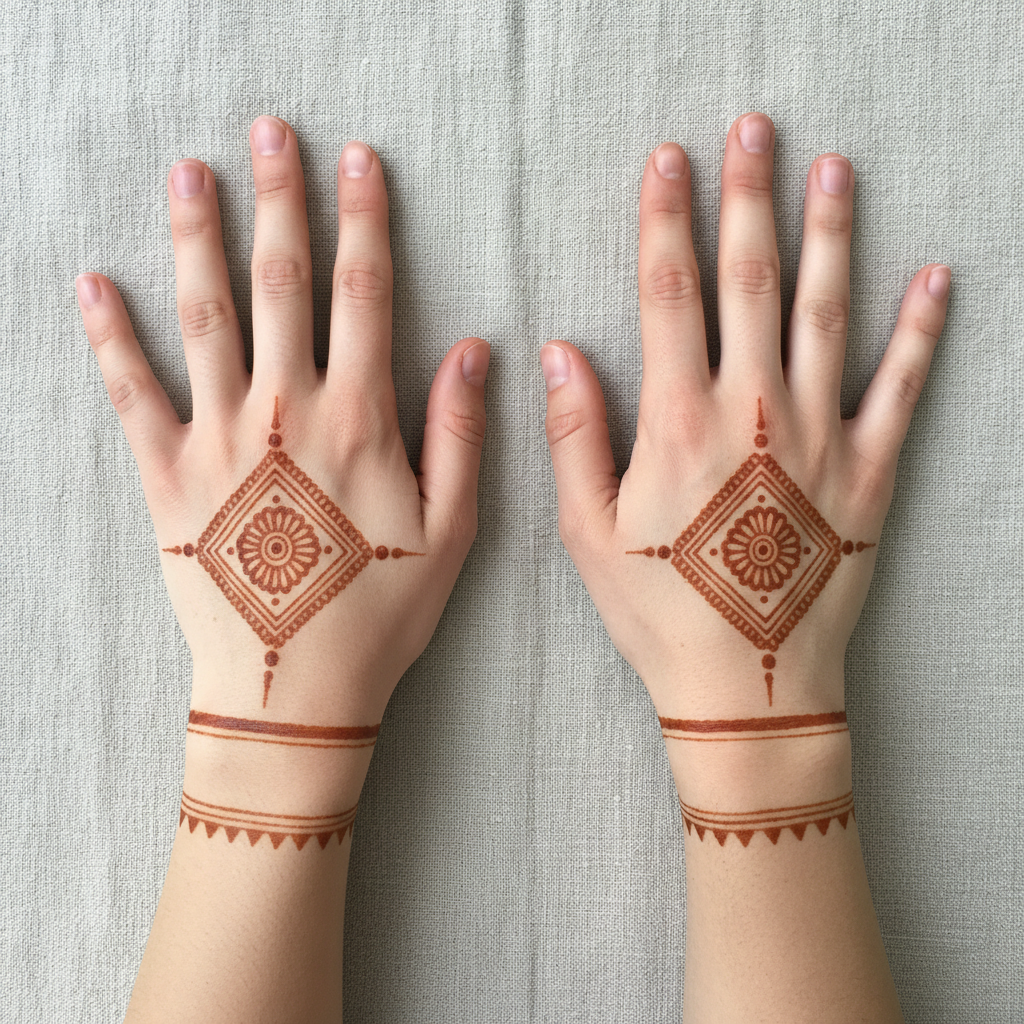
A Real Left Hand, a Real Right Hand, and a Mirror That Holds
The test everybody assumes an image model fails. Two hands, backs up, side by side, each carrying the same knuckle motif and wrist cuff as exact mirror images. Check the handedness before the pattern: the left hand runs thumb, index, middle, ring, little from the outside in, and the right hand runs little, ring, middle, index, thumb — genuinely one of each, not the same hand pasted twice and flipped. Ten digits, correct lengths, correct nails, correct knuckle creases. Then the two knuckle diamonds: dotted outline, two concentric rules, a radiating rosette with a bullseye centre, four inner dots and a teardrop on each of the four points, and they match each other closely enough that you would accept it from a person. One thing did drift, and it is the counting-adjacent one again. The brief said one straight cuff band of small triangles across the wrist. Each arm came back with two bands, and the upper band on both arms has no triangles in it at all.
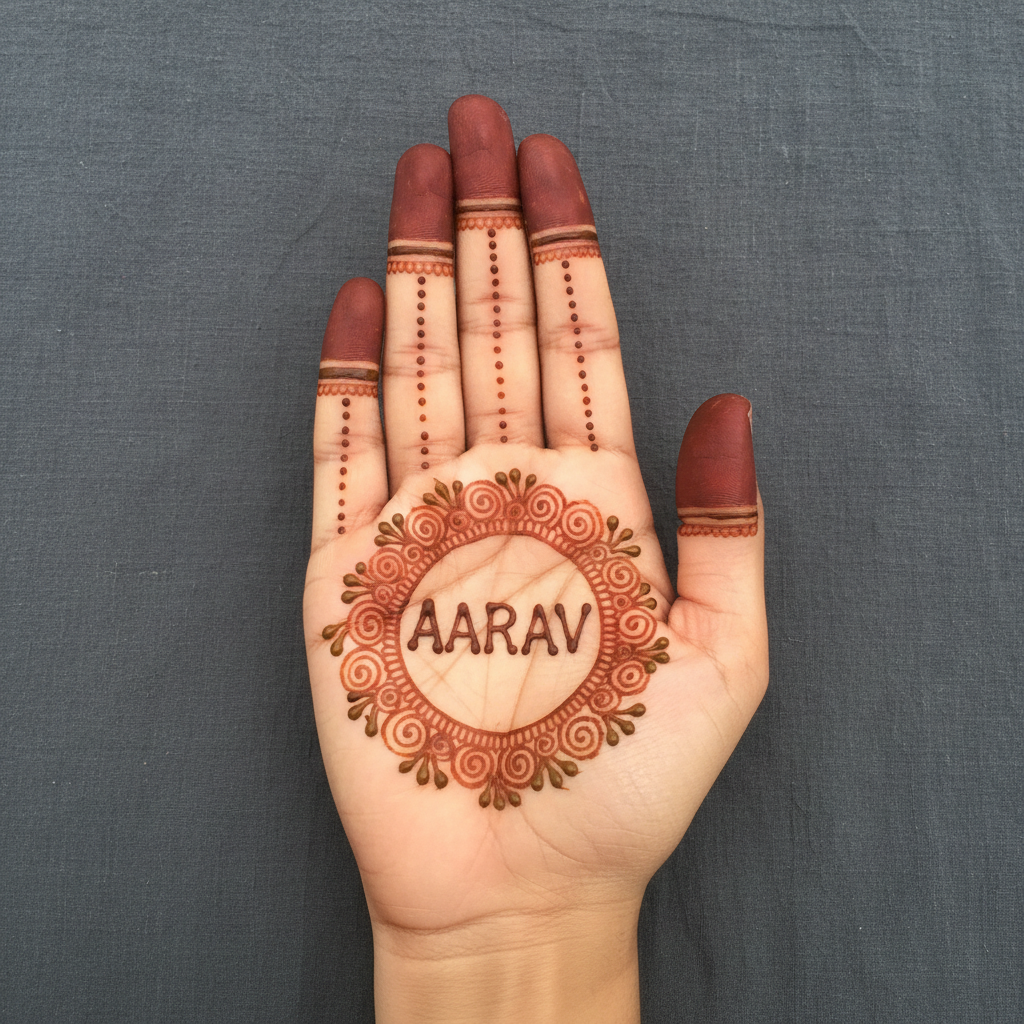
The Hidden Name Trick, Spelled Right, in Real Cone Letterforms
Hiding the groom or bride name in the palm is the single most requested bridal mehndi custom, and it is also a spelling test, which is usually where an image model falls over. It did not. AARAV, five capital letters, once, on one straight line, at one size, no stray accent or dot added anywhere — and drawn in a rounded style with bulbed terminals that reads exactly like paste piped from a cone rather than type dropped on top of a photo. The hand underneath is right again: five digits, correct order, the fingertips dipped solid, each finger carrying a base band and a running column of dots. The one thing it quietly downgraded was density. It was asked for a bridal design and produced a single medallion with finger dots, which is a pretty everyday mehndi rather than a bridal one. Ask for a name and you get the name; ask for a name and bridal coverage and you get the name.
All six were generated at 1:1 — the same model and the same ratio the tool above is locked to — so these are what the presets actually produce, not a showreel shot at a different size. Each brief named an exact number and demanded that the repeated elements be identical, so that the drawing and the repetition could be judged separately.
The Hands Are Right. All Ten of Them.
This is the finding that has to come first, because it is the opposite of what everyone expects from an image model asked to draw a hand. Three of the six renders are photographs of hands, and every hand in them is anatomically correct. The bridal palm: one thumb, four fingers, each separated by a visible gap, correct relative lengths, every fingertip inside the frame. The hidden-name palm: the same, with the fingertips dipped solid the way real bridal work is done. The two-hand render is the strict test and it passed too — a genuine left hand running thumb, index, middle, ring, little from the outside in, beside a genuine right hand running little, ring, middle, index, thumb, rather than one hand duplicated and flipped. Ten digits, correct nails, correct knuckle creases, believable dried-mehndi stain with soft edges. If you have been avoiding an ai henna design generator because of what image models do to hands, that objection is out of date.
It Can Count. It Cannot Make Two Things the Same.
Every brief named an exact number, and the numbers came back right. Eight paisley motifs asked for, eight delivered. Eight mandala petals asked for, eight delivered, each carrying exactly the three internal lines specified. Five flowers on the Arabic trail asked for, five delivered, evenly spaced. Three for three on arithmetic. What drifted every time was sameness. The eight mandala petals are three different shapes — tall ogees north and south, flat lozenges east and west, broad leaves on the diagonals — not one petal repeated eight times. The five Arabic flowers each have six petals rather than the five specified, so it held a count it invented perfectly while missing the count it was given. And on the bridal palm, where one repeating band was asked for around each of the four fingers, four different fills came back: two leafy vines with different leaf counts, one plain column of dots and one short sprig. Zoom into that ring-finger vine and the leaves on the left of the stem are fatter and fewer than the ones on the right. For mehndi this is the fault that matters, because mehndi is almost entirely repeated and mirrored motifs.
The Repeat Holds When It Is Alone in the Frame
The previous panel is not the whole story, and the exception is the most useful thing on this page. Two of the six renders repeat perfectly. The eight-paisley border strip is one row of one motif on a flat sheet, and at full zoom the eight match: same hook curl, same outer and inner teardrop, same fine parallel hatching, same crosshatched skirt on the shared baseline, even gaps throughout. The two-hand mirror is the second — two knuckle diamonds with dotted outlines, concentric rules, a radiating rosette and a bullseye centre, matching each other closely enough that you would accept it from a person. What separates those two from the bridal palm is how much the repeat had to negotiate. A flat sheet, one motif, one straight row, nothing else in the picture: it holds. The same repeat wrapped around four fingers of four different lengths, curving away from the camera, competing with a palm medallion: it drifts. That single distinction is why four of the six presets in the tool above render as flat reference sheets rather than as designs already on skin.
Names Come Out Spelled Right — Medium Instructions Do Not
Hiding a name in the palm is the most requested bridal custom there is, and it worked on the first attempt. Five capital letters, once, on one straight line, at one size, no stray accent or dot added anywhere, and drawn in rounded letterforms with bulbed terminals that read like paste piped from a cone rather than a font laid over a photograph. The instructions it quietly ignored were all about medium rather than content. The Arabic sheet was told clean flat line work with solid filled petals and no shading; every petal came back outlined and hollow with fine radiating line-fill. All three flat sheets were told plain empty white paper; all three came back a soft grey with a vignette in the corners. The mandala was told one small solid dot at its centre ringed by fine dots, and returned an empty white circle inside two rings of petal scales. The two-hand render was told one straight cuff band of small triangles, and each arm came back with two bands, the upper one carrying no triangles at all. None of these ruin a design you are going to trace from — but they are worth knowing before you run twenty renders expecting one particular finish.
Generate the Design Book. Pipe the Repeat Yourself.
Everything above points at one working method, and it happens to be the method mehndi artists already use. Nobody pipes from a stencil; they keep a book of designs and work freehand from a reference. That is exactly what this tool is good for. You get the motif, the composition, the style and — on the presets that matter — a genuinely clean repeat you can trace a cuff or an ankle band from. What you do not get is a guarantee that the eight petals in a medallion are the same petal, or that the band on your index finger will match the band on your ring finger. A cone in a practised hand supplies that for free. The practical sequence is short: generate at 1:1, check the one element that had to be identical twice, print the sheet, and pipe it freehand. Fifteen seconds of generation replaces the part that used to take an evening — working out what the design should be — and leaves you doing the part you are already better at than any model.
How the AI Henna Design Generator Works
Three steps, and the third one is what puts the design on skin
Pick a Mehndi Style
Six presets: Indian bridal, Arabic floral trail, mandala medallion, repeat border strip, minimal fine-line and Moroccan geometric. Type a name, a motif or an occasion in the box if you want one — the presets work with nothing typed at all.
Generate and Check the Repeat
About fifteen seconds per square design. Before you keep it, look at the thing that had to be the same twice: the petals in a medallion, the bands down four fingers, the two sides of a single vine. That is the one place this model drifts.
Print It and Trace From It
The step that makes the design wearable. Print the sheet, pick the motif, and pipe it on freehand — a human cone supplies the repetition and the mirroring, which is exactly the part the gallery above shows the model cannot guarantee.
Henna, Ink or Pattern — Picking the Right Page
This page designs mehndi for skin. For permanent body art with a different visual language, the AI tattoo generator is the right page. For the circular geometry on its own, at poster scale rather than palm scale, use the AI mandala generator or the AI pattern generator. Same hands, different craft: the AI nail art generator works from a photo of your own manicure. For the rest of a wedding or festival season, the AI wedding invitation generator and the AI Diwali card generator share the same motif vocabulary. To take a design off skin and onto cloth or paper, try the AI embroidery design generator and the AI coloring page generator. For a clean traceable outline or a print-sized file, use the AI line art generator and the AI image upscaler.
Why Use This Henna Design Generator
Because a client design book used to take a season to draw
Hands It Actually Draws Correctly
Three photographic renders, three anatomically correct hands: five digits each, correct lengths, correct nails, and a genuine left and right in the two-hand mirror. The failure everybody expects from an image model on this subject did not occur once.
Border Strips Are Its Best Trick
Asked for eight identical paisley motifs on one baseline, it returned eight that genuinely match. The repeat holds when it is alone in the frame, which is why a border-strip preset sits in the tool rather than only in the gallery.
Names Spelled Right, in Cone Lettering
The hidden-name palm came back with the right five capitals, once, on one line, with no stray marks — and drawn as piped paste rather than a font laid over skin. Type any name in the box and it carries through.
Six Real Mehndi Traditions
Indian bridal, Arabic floral, mandala medallion, repeat border, minimal fine-line and Moroccan geometric. Enough range to build a client design book that looks like a book rather than six unrelated pictures.
Flat Sheets Built for Tracing
Four of the six presets render as flat reference sheets on paper rather than photographs on skin, because a sheet is what you print, pin up at a stall and trace from. Square 1:1, straight into a design book page.
Free, No Sign Up, No Watermark
Generate as many henna designs as you like without an account, and nothing is stamped on the result. Paid plans start at $2.99 and buy volume rather than features.
Who Uses It
Mehndi artists, brides, festival stalls and people practising at home
Mehndi Artists
A client design book is the thing that wins the booking, and drawing twenty pages of it by hand is a season of evenings. Generate the references, print them, and keep the freehand work for the skin — which is where you were always going to supply the repeat anyway.
Brides and Bridesmaids
Deciding what you want before you sit down with an artist is most of the stress of bridal mehndi. Generate ten full-hand designs, pick the one, and take the picture to the booking. The hidden-name preset spelled a five letter name correctly on the first try.
Festival and Pop-Up Stalls
A printed sheet of small designs at a stall means a queue picks quickly instead of describing. The repeat border strip is the strongest render this model produces and is exactly what a five minute wrist or ankle band needs.
Eid, Karva Chauth and Home Practice
Festival weeks are when everyone wants a design and nobody can get an appointment. Minimal fine-line and single medallion references are the realistic ones to attempt at home with a cone, and they print at a size you can prop next to your hand.
AI Henna Design Generator FAQ
Stencils, hands, hidden names, mehndi styles, sizes and what it costs
Free AI Henna Design Generator — A Mehndi Design Book in an Afternoon
Mehndi has always been two skills pretending to be one. There is the design — deciding what goes on the palm, what runs down the fingers, where the cuff sits, which motif repeats along a border — and there is the piping, which is muscle memory in a steady hand. An ai henna design generator collapses the first one from an evening of sketching into about fifteen seconds. Pick a style, wait, and you have a square design: Indian bridal, Arabic floral trail, mandala medallion, repeat border strip, minimal fine-line or Moroccan geometric. No account, no watermark, and as many attempts as you want. The second skill stays exactly where it was.
Four of the six presets on this henna design generator deliberately render as flat reference sheets on paper rather than as finished work already on a hand. That is not the tool running short of ambition, it is the finding from the gallery above turned into a design decision. This model repeats cleanly when the repeat is the only thing in the frame and drifts when the repeat has to wrap around four fingers of four different lengths. So the presets ask for what it does well — one motif, one row, one sheet — and leave the wrapping to a cone in your hand, which is how a design book has always worked.
Three findings sit behind that, all demonstrated in the images rather than asserted. The first is that the hands are right. Ten digits across three photographic renders, correct lengths, correct nails, correct knuckle creases, and a genuine left hand beside a genuine right hand rather than one flipped copy — the objection people have been carrying about AI and hands does not apply to these renders. The second is that it can count but cannot duplicate. Eight paisleys asked for and eight delivered, eight mandala petals asked for and eight delivered with exactly three internal lines each, five flowers asked for and five delivered — and yet the eight petals came back in three different shapes, the five flowers each grew a sixth petal, and the four fingers of the bridal palm received four different bands where one repeated band was specified. The third is that the exception is useful. The eight-motif border strip on a flat sheet is a genuine repeat, clean enough to trace a wrist cuff or an ankle band straight off, and the mirrored knuckle diamonds on two hands match as well as a person would manage.
So the method is short: let the model design the mehndi, check the element that had to be identical twice, print the sheet, and pipe it freehand. Names come through spelled correctly, which covers the most requested bridal custom there is. The neighbouring pages finish the job — permanent body art at the AI tattoo generator, circular geometry at poster scale at the AI mandala generator and the AI pattern generator, the same hands and a different craft at the AI nail art generator, the rest of the wedding at the AI wedding invitation generator, the same motifs on cloth at the AI embroidery design generator, a traceable outline at the AI line art generator, and a print-sized file at the AI image upscaler. Everything here is free to try, nothing is watermarked, designs come back square at 1:1, and paid plans start at $2.99. Scroll back up, make one, and compare the motifs before you trace twenty.