AI Baby Shower Invitation Generator
It Letters Every Name Right. Count the Balloons Yourself.
Pick a style, type the mother-to-be name, the date and the time, and get a print-ready 3:4 invitation back in about fifteen seconds — watercolour florals, a boho arch, a nursery elephant, blush and gold balloons, safari friends or modern minimal. This ai baby shower invitation generator is free, needs no account and adds no watermark, and the gallery below shows all six cards exactly as they came back, including the one that miscounted.
Try the AI Baby Shower Invitation Generator — Free
Pick a style, type the name and the date, and print the card
AI Baby Shower Invitation Generator
Choose one of the six styles below, then type the real details into the box — the mother-to-be name, the date, the time and the venue if you have one. They get lettered into the artwork rather than pasted on top of it, so the card comes back finished. Every card returns at 3:4 portrait, the closest standard ratio to a printed 5x7 invitation.
Every style returns a 3:4 portrait card. Whatever you type in the details box is lettered onto it — so give it the real name, the real date and the real time, then read the finished card before you print a stack.
AI Baby Shower Invitation Generator Examples
Six cards exactly as they came back — read the type, then count the balloons
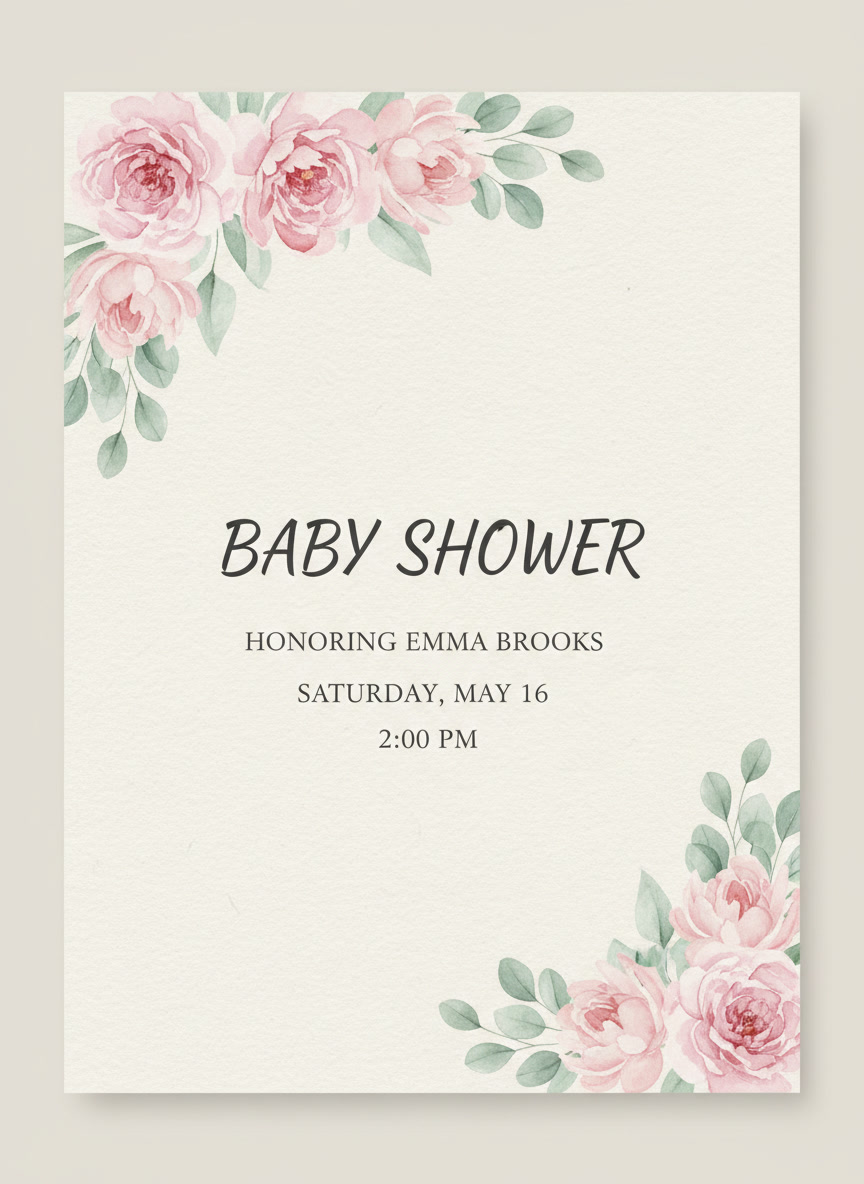
Four Lines of Type, Four Lines Correct — Including the Comma and the Colon
This is the whole reason a baby shower invitation is a hard thing to generate: it is mostly words, and they are words that have to be right. Here all four lines came back letter perfect — BABY SHOWER in script, HONORING EMMA BROOKS in spaced capitals, SATURDAY, MAY 16 and 2:00 PM. Look at the punctuation specifically, because that is where this kind of model usually gives itself away: the comma after SATURDAY is correctly placed and correctly kerned, and 2:00 PM has a real colon with two zeros after it rather than the smear of marks you often get. The peonies and eucalyptus are genuine watercolour, with visible paper tooth behind them and the centre of the card left clean for the type exactly as asked. The one thing it did not do is fill the frame — see the third card below, and the framing note further down.
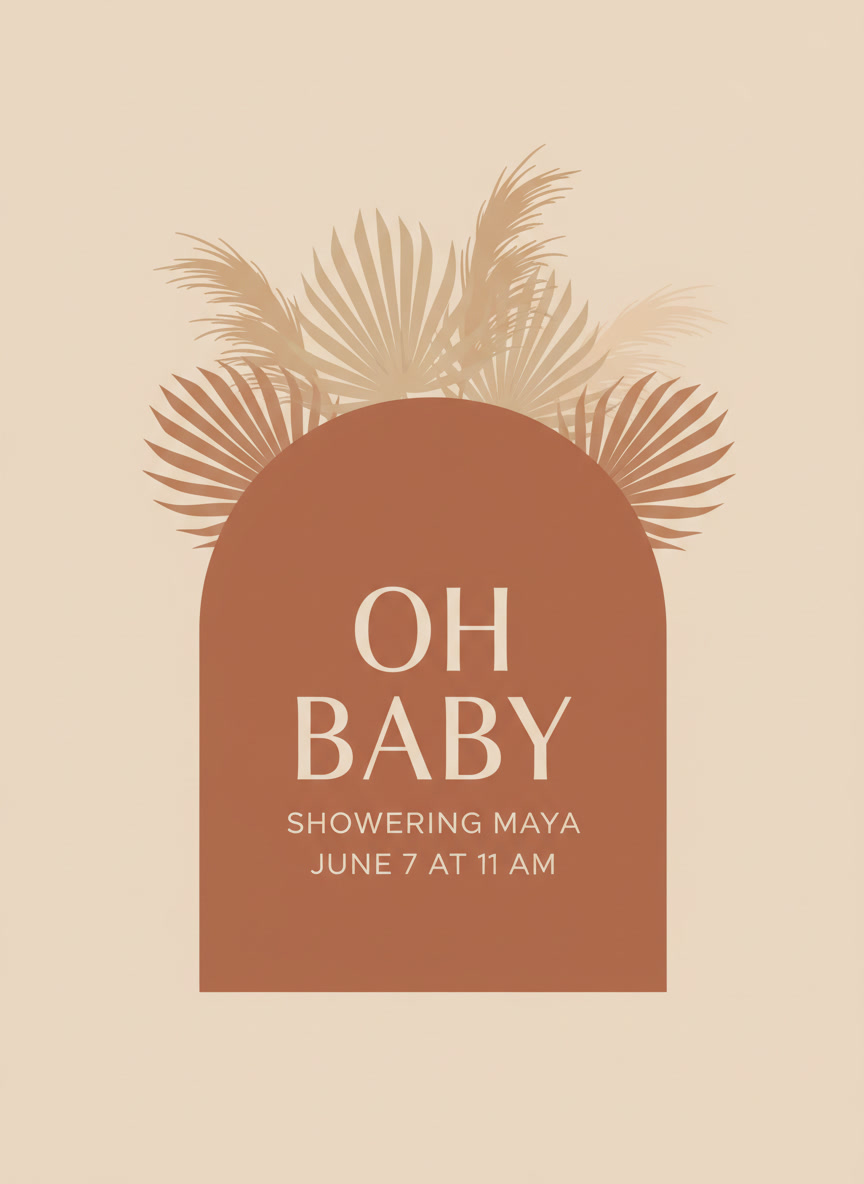
The Boho Arch, Edge to Edge, With Pampas That Sit Behind the Shape
The single most requested baby shower look of the last few years, and the one that most template sites flatten into a sticker. What makes this render work is depth: the terracotta arch is a solid flat shape, and the dried palm fronds and pampas fan out from behind its top edge rather than being pasted on top of it, with the paler fronds reading as a second layer further back. OH BABY, SHOWERING MAYA and JUNE 7 AT 11 AM are all correct. Two small liberties worth knowing about, because they tell you how the model reads a brief: OH BABY was asked for on one line and came back stacked on two, which is the better setting here, and this card obeyed the full bleed instruction that the first one ignored. Same session, same clause, two different answers.
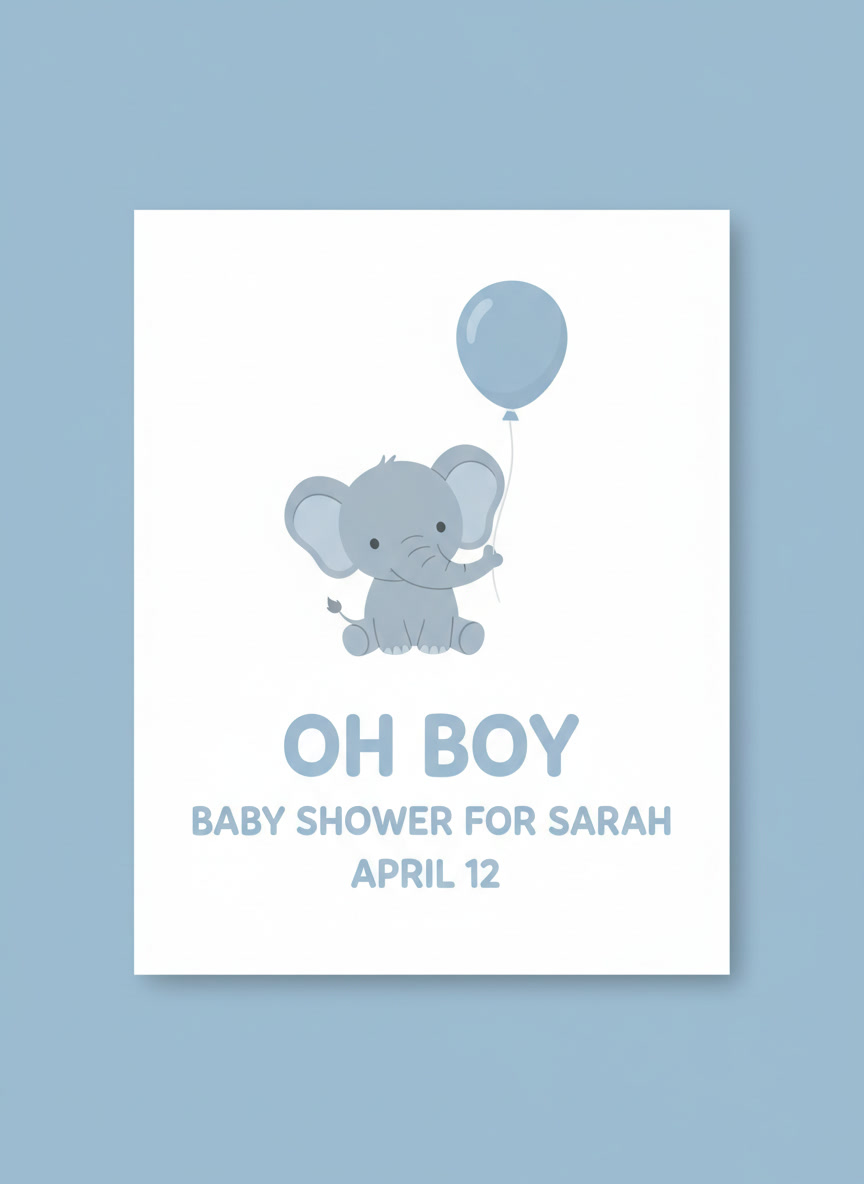
A Clean Nursery Card — That Filled Less Than Half of Its Own Frame
The card itself is right. One elephant calf, correctly proportioned with the ears and trunk a nursery illustrator would draw, holding exactly one balloon whose string is actually gripped by the trunk rather than floating near it. OH BOY, BABY SHOWER FOR SARAH and APRIL 12 are all spelled correctly in a rounded sans that matches the artwork. The problem is everything around it. The brief asked for a powder blue and white card filling the frame edge to edge, and what came back is a white card photographed on a powder blue surround with a drop shadow — the blue moved from the card to the background. Measured off the file the card occupies 71.3 percent of the width and 66.4 percent of the height, which is 47.3 percent of the image. Less than half. That is a crop, not a flaw, but you have to know to make it.
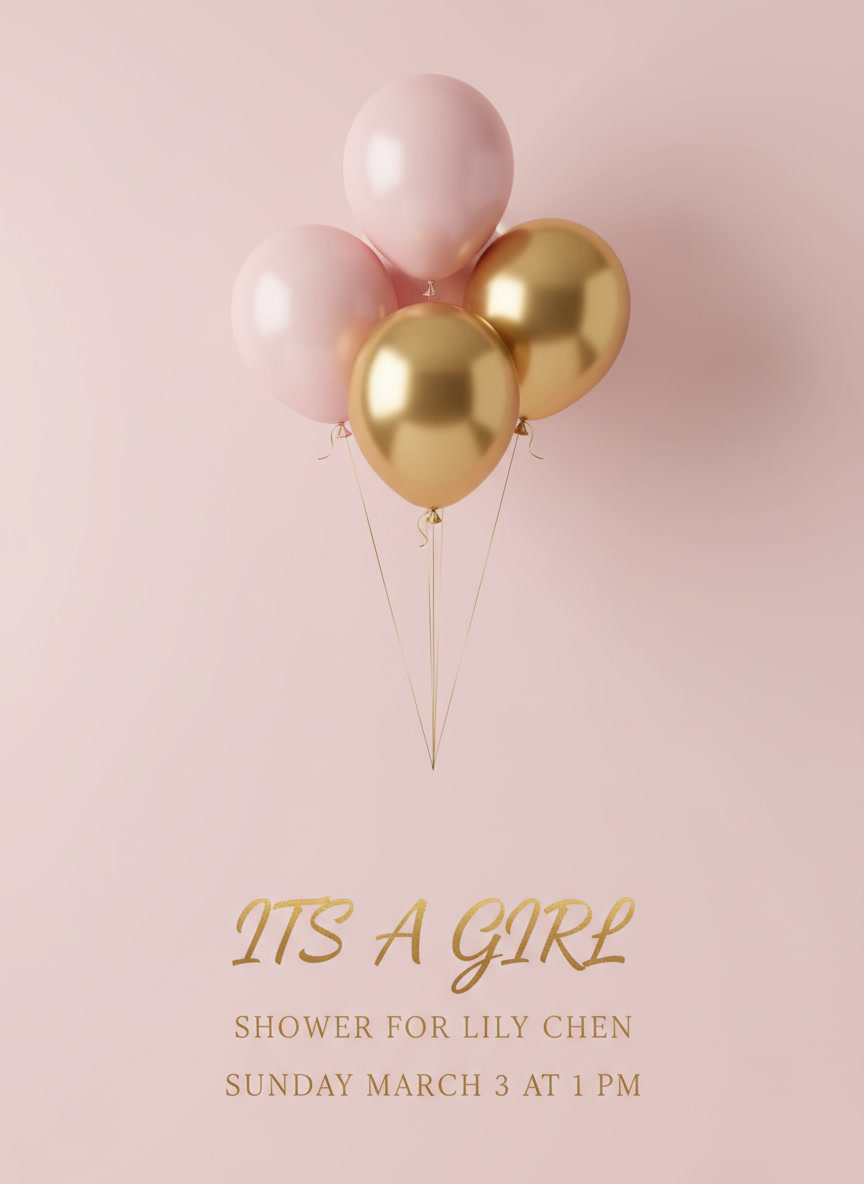
Five Balloons Asked For. Four Balloons Delivered. Nothing Looks Wrong.
This is the single most useful image on the page, and you have to be told what to look at. The brief asked for exactly five balloons, three matte pink and two metallic gold. Count them. There are four: two pink and two gold. The gold count is right, the pink count is one short, the total is one short, and the render gives you no clue at all — there are four knots, four ribbons, and the four strings converge to a single point at the bottom exactly as real balloons would. It is internally consistent, beautifully lit, and simply not what was ordered. Meanwhile every word is perfect: ITS A GIRL in gold script with the apostrophe correctly omitted as instructed, SHOWER FOR LILY CHEN, and SUNDAY MARCH 3 AT 1 PM. That is the shape of this model on invitations — it letters your text and miscounts your objects, which is the opposite of what everyone expects.
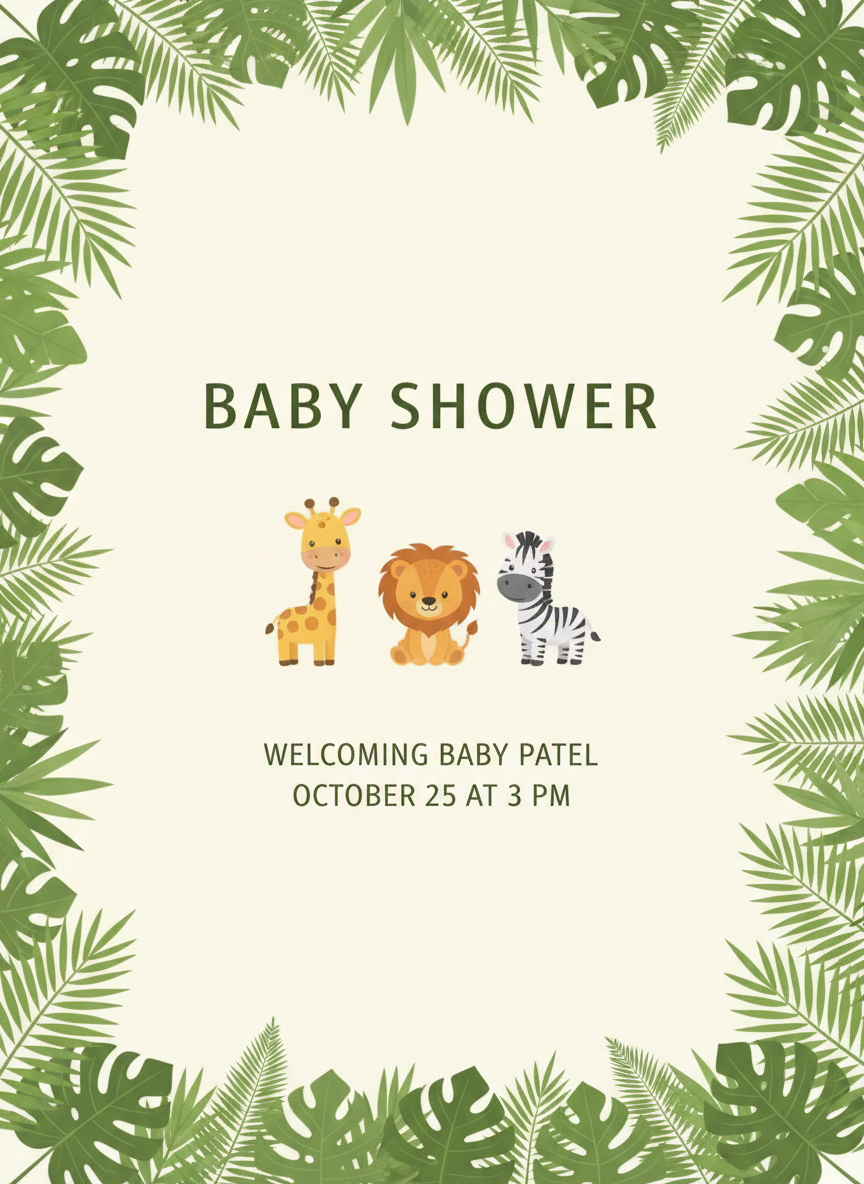
Three Animals, Right Order, Right Count — and a Border It Was Told Not to Draw
The counting test passed here, which is what makes the balloon card above worth taking seriously rather than dismissing. Exactly three safari animals were asked for in one horizontal row, left to right a giraffe, a lion cub and a zebra, and that is precisely what arrived, in that order, evenly spaced, each drawn in the same flat storybook style. BABY SHOWER, WELCOMING BABY PATEL and OCTOBER 25 AT 3 PM are all correct. What it ignored was an exclusion: the brief said leaves down the left and right edges only, with the top and bottom left plain, and the render wrapped a full four-sided wreath around the card. Note the pattern across this whole set — positive instructions land, negative ones get overruled by whatever the style normally looks like, and a jungle border normally goes all the way round.
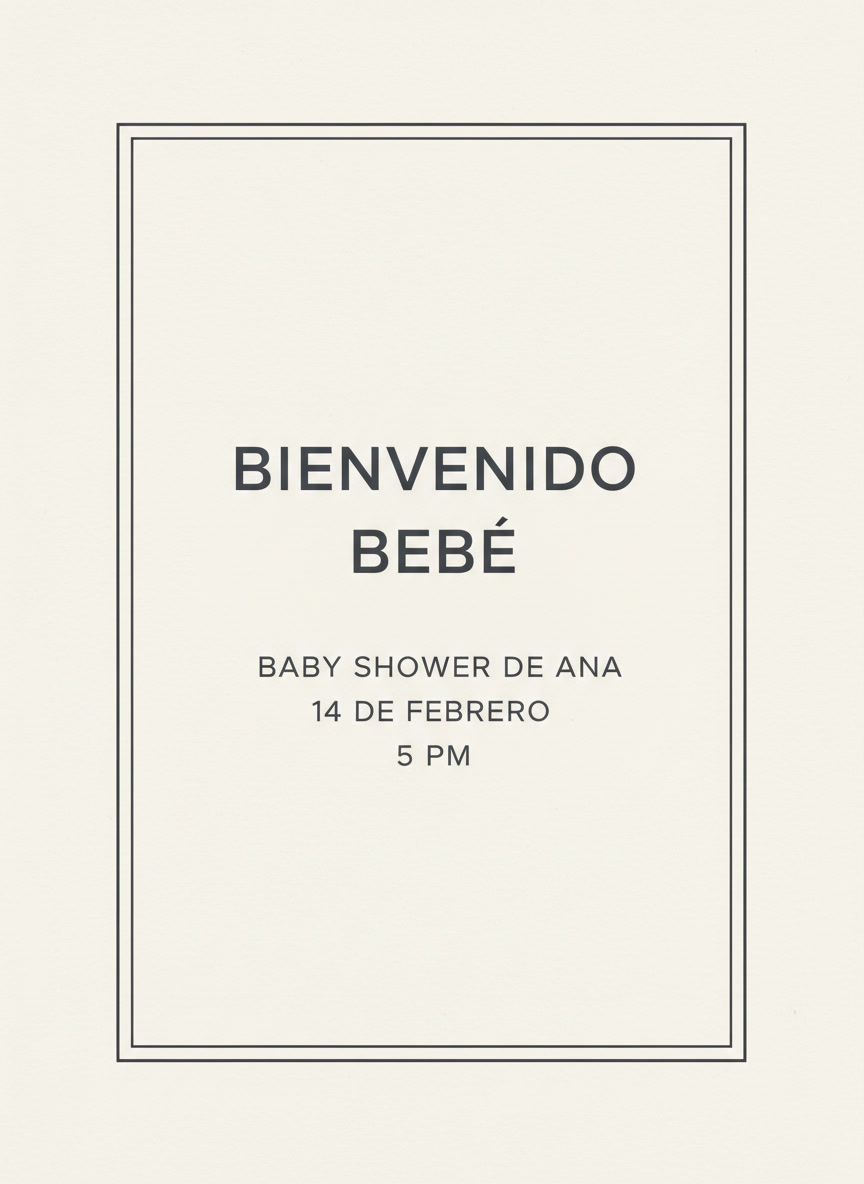
BEBÉ — One Acute Accent, on the Right Letter, Leaning the Right Way
This card was written to fail and it passed cleanly. Accents are the classic failure of image models on non-English text: they get invented on words that do not take them, or they arrive as a grave where the language needs an acute, and they look like good typography while being wrong. The brief asked for exactly one accent, on the final E of BEBÉ, and banned every other mark on the card. Crop the word and you can see the stroke rising left to right — a true acute, on the correct letter, while the first E of BEBÉ is clean. BIENVENIDO, ANA and FEBRERO are all correctly unaccented. So a Spanish, French or Portuguese baby shower invitation is a reasonable thing to ask this tool for, as long as you name the accent you want and where it goes. The double rule frame is the model improving on a brief that asked for a single one.
All six were generated at 3:4 — the same model and the same ratio the tool above is locked to — so these are what the presets actually produce rather than a showreel shot at a different size. Each brief named the exact words to letter and, where it mattered, the exact number of things to draw, so that spelling, accents and counting could be judged separately.
Count the Balloons. It Will Not Count Them For You.
This is the defect that matters on an invitation, and it is invisible. One card was asked for exactly five balloons, three matte pink and two metallic gold. Four came back: two pink, two gold. The gold count is right and the pink count is one short, and every supporting detail agrees with the wrong answer — four knots, four ribbons, four strings converging to one point at the bottom of the cluster. Nothing in the image looks broken, which is exactly why it survives a glance and ends up printed fifty times. It is not a blanket failure either: the safari card was asked for three animals in a left-to-right order and delivered a giraffe, a lion cub and a zebra in that exact order, and the elephant card delivered one elephant holding one balloon. So it is a per-render lottery, and the check is ten seconds long. If your design repeats anything — balloons, animals, stars, hearts, candles — count them on the finished card before you order.
The Lettering Is the Strong Side — Six Cards, Six Clean Sets of Type
This is the opposite of what people expect from an image model, and it is the reason this page exists. Every printed word across all six cards came back correct: EMMA BROOKS, MAYA, SARAH, LILY CHEN, PATEL and ANA, plus every date and time line. The punctuation held too, which is the finer test — the comma in SATURDAY, MAY 16 is placed and kerned correctly, and 2:00 PM has a real colon with two zeros behind it rather than the smear of marks this kind of model usually produces at small sizes. ITS A GIRL was asked for without an apostrophe and arrived without one. The type is also lettered into the artwork rather than pasted on top of it, which is why the gold script on the balloon card picks up the same foil sheen as the balloons. Give the details box the real name and the real date and you can reasonably expect them back correctly spelled — but read the card once anyway, because the letters are drawn rather than typed.
BEBÉ Came Back With Exactly One Accent, on Exactly the Right Letter
Accents are the classic way an image model spoils a non-English card, and it spoils them beautifully — an acute invented on a word that never takes one, or a grave where the language needs an acute, set so cleanly that it reads as typography rather than as an error. The minimal card was written as that trap: one accent requested, on the final E of BEBÉ, every other mark on the card banned. It placed exactly one accent, on exactly that letter, and the stroke rises left to right — a true acute, not a grave. BIENVENIDO, ANA and FEBRERO all came back clean, and the first E of BEBÉ is unmarked. That makes a Spanish, French, Portuguese or Italian baby shower invitation a reasonable thing to ask for here, on one condition: name the accent and say where it goes rather than trusting the model to know. Non-Latin scripts such as Chinese or Arabic are a different matter and need checking character by character before you print.
Two Cards Out of Six Framed Themselves Instead of Filling the Page
All six briefs ended with the same clause: fill the frame edge to edge, no matte, no drop shadow, no border. Four obeyed and two did not. The watercolour card came back sitting on a soft putty-grey matte, filling 87.4 percent of the width and 86.7 percent of the height — about three quarters of the image. The elephant card is the bigger miss: it returned as a white card photographed on a powder blue surround with a drop shadow, occupying 71.3 percent of the width and 66.4 percent of the height, which is 47.3 percent of the image. Less than half. Worse, the powder blue that was specified as the card’s own background is what became the surround, so the colour moved rather than disappeared. On a white page that margin is invisible; on a printed 5x7 with a full bleed it is not. One pass through the AI image cropper removes it, and the AI image upscaler puts the resolution back for a large print run.
Tell It What to Draw, Not What to Leave Out
A pattern runs through all six cards and it is the most useful thing to take away from this page. Positive instructions land almost every time: put a terracotta arch in the middle, put three animals in a row, letter this name in spaced capitals, put the pampas behind the arch — all delivered. Exclusions are the ones that get overruled by whatever the style normally looks like. The safari card was told to run leaves down the left and right edges only, leaving the top and bottom plain, and came back with a full four-sided wreath, because that is what a jungle border normally does. The full bleed clause is the same kind of instruction — a request for the absence of a matte — and it failed twice out of six. So phrase what you want as something to add. “Leaves down the two side edges and a plain cream strip across the top” will beat “no leaves at the top” every time, and the same trick works for empty space you want left for handwriting.
How the AI Baby Shower Invitation Generator Works
Three steps, and the third one is ten seconds of counting
Pick the Style
Watercolour Floral, Boho Arch, Little Elephant, Blush and Gold, Safari Friends or Modern Minimal. Each one is a complete design brief — the palette, the illustration and the type treatment come together, so you are choosing a finished card rather than assembling one.
Type the Name, Date and Time
Use the details box under the style buttons. Give it the mother-to-be name, the date, the time and the venue if you want one, and they get lettered onto the card. About fifteen seconds per render, and every name on the six test cards came back correctly spelled.
Count, Proofread, Then Print
Two checks before you order a stack. Read the date and time line, and count anything the design repeats — balloons and animals are where this model slips, and it slips invisibly. Then print at 3:4, the closest standard ratio to a 5x7 card.
Invitation, Announcement or Thank You — Picking the Right Page
This page makes one thing: the card that invites people to the shower. If you are still telling everyone the news, the AI pregnancy announcement generator is the page before this one, and the AI baby generator is the party game people play once they arrive. For a wedding in the same family use the AI wedding invitation generator, and for the thank you notes afterwards the AI greeting card maker and the AI birthday card generator carry the same lettering strengths. Decorating the room is a different job: the AI event poster designer handles welcome signs, the AI sticker generator does favour labels, and the AI photo collage maker turns the day’s photos into something to send round afterwards.
Why Use This Baby Shower Invitation Generator
Because the template sites give you a text box, and this one letters the card
It Letters Names Correctly
Six for six on spelling across the test set, punctuation included: the comma in SATURDAY, MAY 16 and the colon in 2:00 PM both survived. Names, dates, times and venues are lettered into the artwork rather than dropped into a text box on top of it.
Accents Where You Ask For Them
BEBÉ came back with a true acute on the final E and no stray marks on BIENVENIDO, ANA or FEBRERO. Name the accent and its position and a Spanish, French or Portuguese baby shower invitation is a reasonable thing to generate here.
Six Complete Styles, Not Six Templates
Watercolour peonies with real paper tooth. A boho arch with pampas layered behind it. A nursery elephant, blush and gold balloons, a safari row and a minimal charcoal rule. Each is designed as a whole card, which is why the type sits inside the artwork instead of on it.
Built for the Actual Occasion
Gender-neutral, boy, girl and language variants all in one place, with wording that suits a shower rather than generic card filler — HONORING, SHOWERING, WELCOMING BABY and OH BABY are all in the presets and all came back clean.
Print-Ready 3:4 Portrait
Every card returns at 3:4, the closest standard ratio to the 5x7 invitation people actually print. Four of the six test cards bled to the edge; the other two need one pass through the cropper, which the page tells you rather than hides.
Free, No Sign Up, No Watermark
Nothing is stamped on the finished invitation, which is the whole problem with most free invitation sites. Generate as many as you like without an account. Paid plans start at $2.99 and buy volume, not designs.
Who Makes Baby Shower Invitations
Hosts, sisters, colleagues and anyone who has priced a stationer
The Person Hosting
Usually a sister, a best friend or the mother-in-law, usually working to a date that got decided last week. Three styles generated side by side takes about a minute, which is short enough to send the family a choice instead of a fait accompli.
Digital Invites and Group Chats
Most showers are organised in a group chat now, and a card that comes back with no watermark drops straight into one. The 3:4 portrait shape reads well in a message thread and on a phone screen without anyone having to pinch to read the date.
Printed 5x7 Cards
3:4 is the closest standard render ratio to a printed 5x7 invitation, so these go to a print shop with very little fuss. Check the edges first — two of the six test cards left a decorative margin that wants trimming before a full bleed run.
Bilingual Families
A shower with relatives on two continents often needs the card in two languages. BIENVENIDO BEBÉ came back with its acute accent in the right place and nothing invented elsewhere, so a Spanish, French or Portuguese card is a realistic ask if you name the accent you need.
AI Baby Shower Invitation Generator FAQ
Names, spelling, accents, sizes, printing and what to double check
Free AI Baby Shower Invitation Generator — The Card Is Mostly Words
A baby shower invitation is a small design problem with an unusual shape: about ninety percent of what matters is text, and all of it has to be exactly right. A name spelled wrong is an apology. A date lettered wrong is an empty room. That is why most people end up on a template site, filling a form field and accepting whatever font it was built with — and why an ai baby shower invitation generator only earns its place if the lettering can be trusted. Pick one of the six styles above, type the mother-to-be name, the date and the time into the details box, wait about fifteen seconds, and the artwork and the type come back designed together rather than stacked on top of each other.
What the six test cards on this page establish is that the lettering is the strong side. Every printed word across all six came back correct — EMMA BROOKS, MAYA, SARAH, LILY CHEN, PATEL, ANA, and every date and time line with them. The punctuation held at small sizes too, which is the finer test: the comma in SATURDAY, MAY 16 sits correctly, and 2:00 PM has a real colon with two zeros behind it. The Spanish card went further. It was asked for exactly one acute accent, on the final E of BEBÉ, with every other mark banned, and that is exactly what it produced — the stroke rising left to right, the first E clean, and BIENVENIDO, ANA and FEBRERO all correctly unaccented. Invented accents are the classic way these models ruin a non-English card, and naming the accent and its position is what prevents it.
The defect is somewhere nobody looks: it cannot count. One card was asked for five balloons, three pink and two gold, and returned four, two of each, with four knots and four ribbons and four strings converging to a single point — wrong, and perfectly self-consistent about being wrong. The safari card, asked for three animals in a stated left-to-right order, delivered exactly three in exactly that order, so this is a lottery rather than a limitation, and the ten seconds it takes to count the objects on your finished card is the single most valuable thing you can do before printing. Framing is the other thing to check: four of the six cards filled the frame as instructed, while the watercolour card came back on a putty matte at 87 percent and the elephant card as a white card on a blue surround filling only 47 percent of the image. Both are one pass through the AI image cropper away from being right, with the AI image upscaler to follow if you are printing a stack.
The last lesson is about how to write the request at all, and it applies to every style on this page. Positive instructions land; exclusions get overruled. Asking for a terracotta arch with pampas fanning out behind it worked perfectly. Asking for leaves down the left and right edges only, with the top and bottom left plain, produced a full four-sided wreath, because that is what a jungle border normally does. So describe what you want added rather than what you want missing — including the space you are leaving for a handwritten note. Then keep going through the rest of the day: the news itself at the AI pregnancy announcement generator, the welcome sign at the AI event poster designer, favour labels at the AI sticker generator, and the photographs afterwards at the AI photo collage maker. Everything here is free to try, nothing is watermarked, cards come back at 3:4, and paid plans start at $2.99. Scroll back up, type the real name and the real date, and count the balloons before you order fifty.