AI Hanukkah Card Generator
A Card in Fifteen Seconds. Check the Hebrew.
Describe the card you want and get back a finished Hanukkah design — a lit menorah, dreidels on linen, sufganiyot under icing sugar, navy and gold. This ai hanukkah card generator is free, needs no account and adds no watermark. It is also, as the gallery below shows at full size, completely unable to spell in Hebrew while looking entirely convincing doing it.
Try the AI Hanukkah Card Generator — Free
Pick a style, add your own details in the box, and count the candles when it lands
AI Hanukkah Card Generator
Choose one of the six Hanukkah card styles below, then use the box underneath to add your own details — your colours, your family, the menorah you actually own, the dog in the kippah. Every preset is deliberately written to produce no lettering and to leave a clean uncluttered area, because this model cannot spell in Hebrew and produces nonsense that looks entirely authentic. Generate the picture here, then add the greeting yourself in any app with a text box. And before you use a card with a menorah on it, count the branches: nine, eight plus a raised shamash in the centre. It got that right twice out of three in the gallery below.
Renders at 3:4 portrait, the shape every card in the gallery below was generated at, and close to a folded card or a 5x7 print. There is no ratio picker on this page, so for a square post or a wide email header, crop the result with the AI image cropper or pick a different ratio on the home page generator.
AI Hanukkah Card Generator Examples
Six cards exactly as they came back — read the Hebrew closely and count every candle
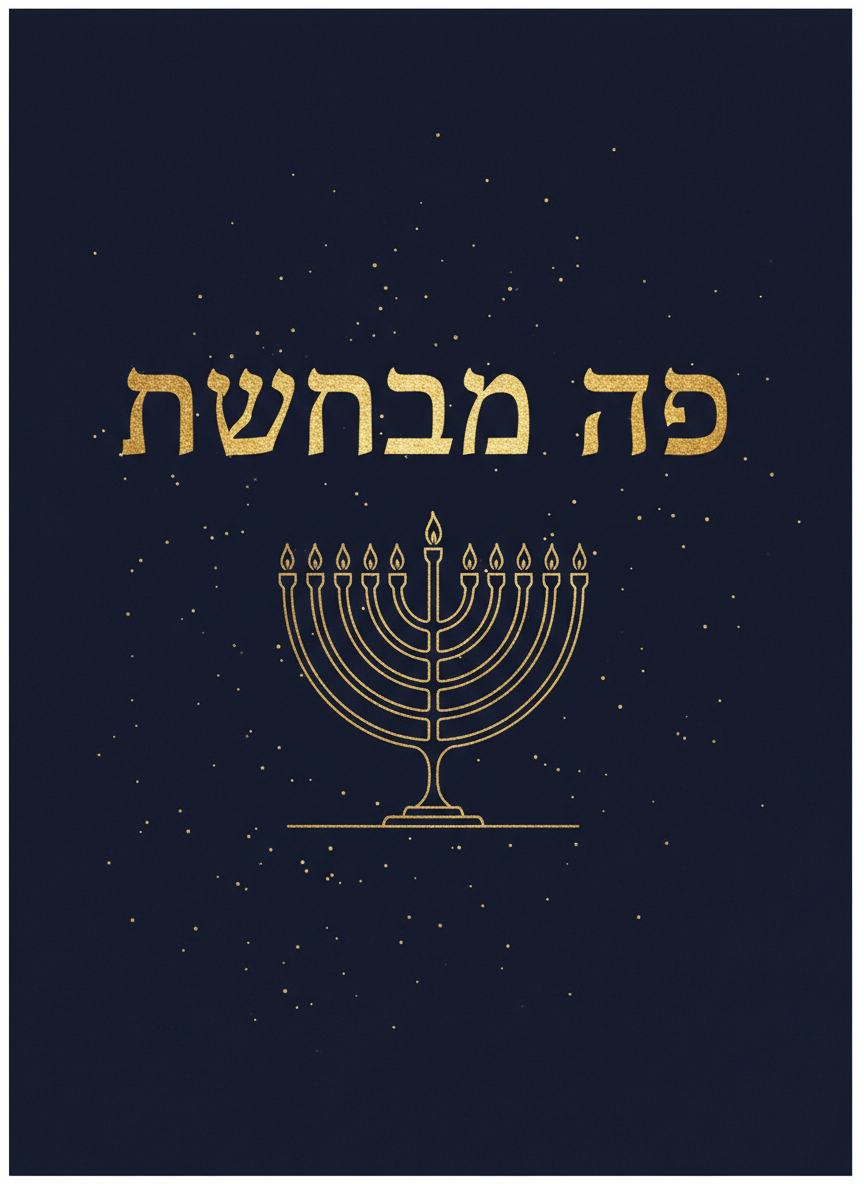
It Asked For “Happy Hanukkah” in Hebrew. It Got Back Two Words That Mean Nothing.
Start here, because this one image is the reason the page exists. The prompt asked for חג חנוכה שמח — chag chanukah sameach, three words, eleven letters, the standard greeting. What came back is פה מבחשת: two words, seven letters, and not the phrase. Every single glyph is a real, correctly drawn Hebrew character — pe, he, mem, bet, het, shin, tav — in a handsome gold foil serif, spaced properly, running right to left as Hebrew should. That is exactly what makes it dangerous. There is no squiggle to spot, no obviously broken letter, nothing that looks like AI output. If you do not read Hebrew you will see confident gold lettering on navy and assume it says what you asked for. It says roughly "here, a stirrer". Then count the menorah underneath: nine branches were requested and eleven were drawn, five on each side of the raised centre. Two errors, one card, and neither is visible to the person most likely to send it.
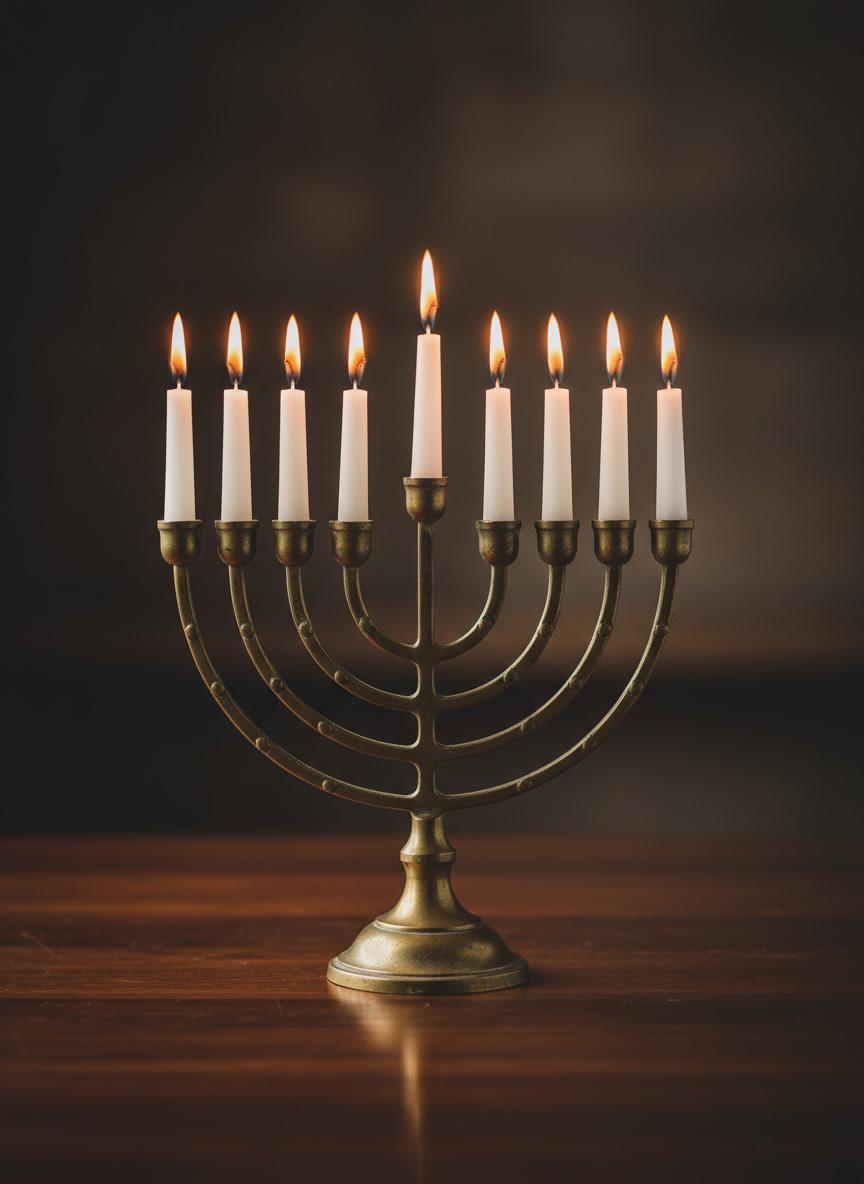
Nine Candles, Correctly, With the Shamash Raised
The relief after the card above, and proof the count is reachable rather than impossible. The prompt spelled the arithmetic out in words — four on the left, four on the right, one ninth candle in the centre held noticeably higher, count them — and that is precisely what arrived. Four, four, one raised shamash, nine flames, every one lit, the eight outer candles level with each other to within a pixel or two. The brass casting is convincing, the warm falloff into darkness is genuinely lovely, and there is nothing here to correct. Hold it next to the gold line drawing above, which asked for the same number in the same run and drew eleven, and you have the honest summary of this tool: nine is something it can do, not something it will do. Across the three menorahs on this page it landed twice and missed once. That is a coin you have to watch flip, not a rule you can rely on.
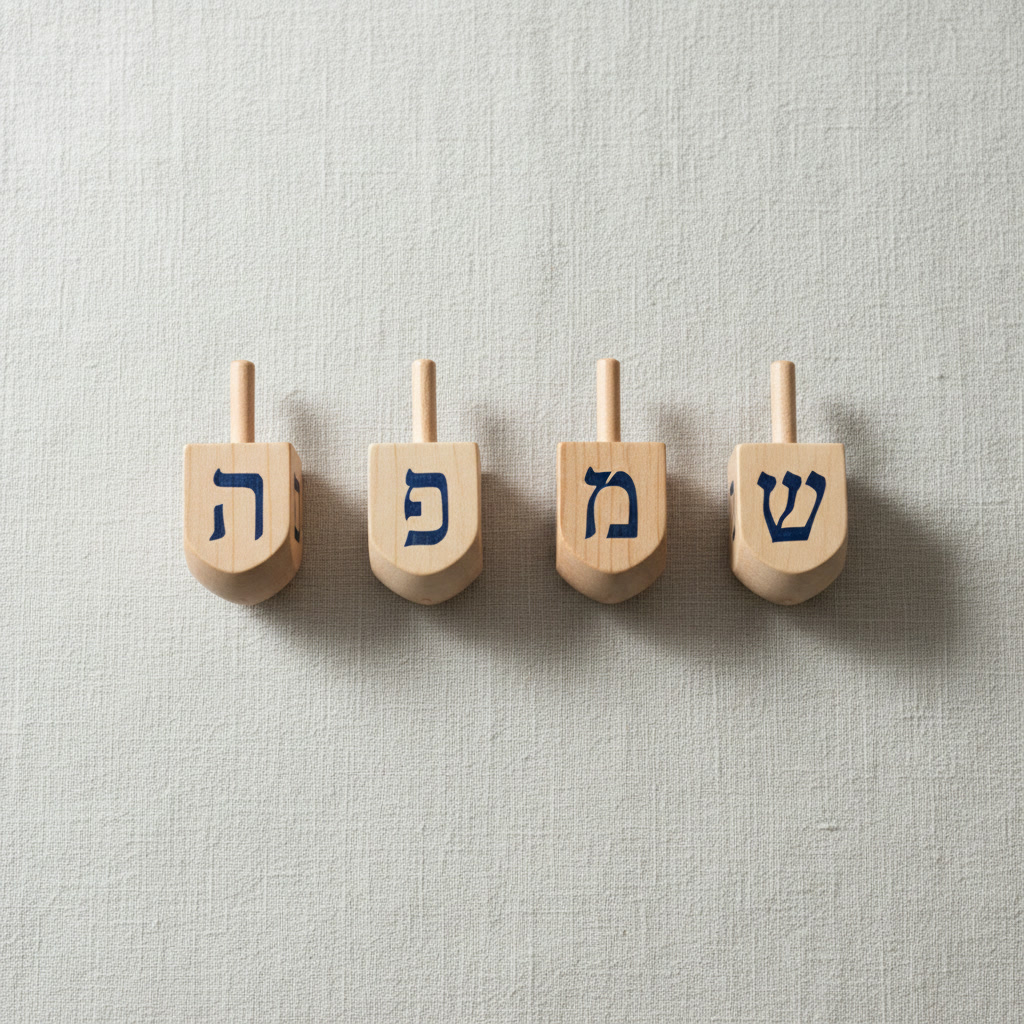
Four Dreidels, Four Hebrew Letters, One of Them Right
The four faces of a dreidel are not decoration, they are a fixed acronym: nun, gimel, hey, shin, for nes gadol hayah sham, a great miracle happened there. Those four letters were named explicitly, in order, left to right. What arrived, left to right, is hey, pe, mem, shin. Only the shin is correct, and it is correct partly by luck of position. Hey is a real dreidel letter sitting in the wrong place. Mem is not a dreidel letter in any tradition. And pe is the strangest miss of all, because it is a genuine dreidel letter — on Israeli dreidels, which read nun gimel hey pe for nes gadol hayah po, a great miracle happened here. The model has quietly welded half of an Israeli set onto half of a diaspora one and dropped nun and gimel, the two letters the phrase begins with. Again, the painting is beautiful: deep blue on bare maple, crisp serifs, real letterforms. It is the meaning that is missing, not the craft. Notice too that the four dreidels are not the matched set that was asked for — the first is larger and angled off the row, the last sits higher than the other three, and the gaps between them are uneven.
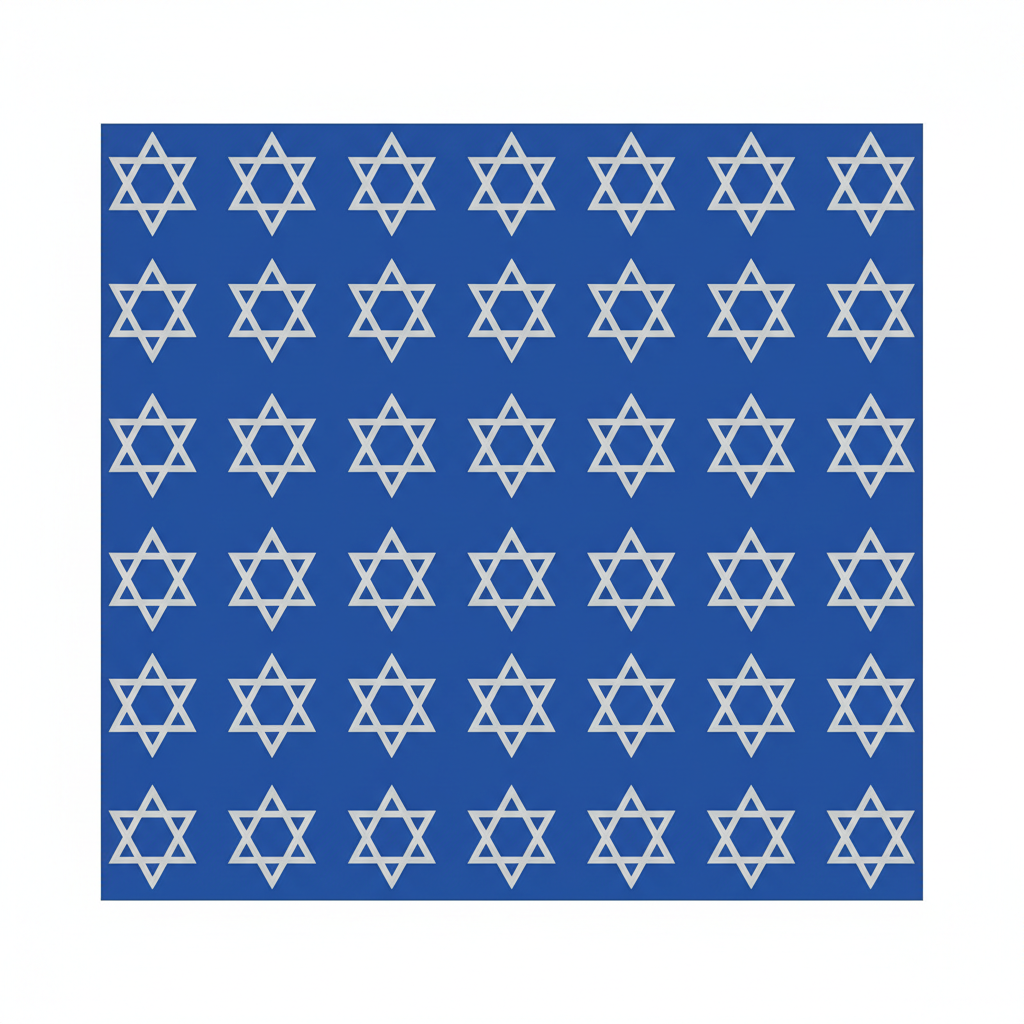
Perfect Repetition of the Wrong Number of Stars, Inside a Border Nobody Asked For
A genuinely useful result with two instructions ignored. What went right is the hard part and worth saying plainly: every star is the identical star. Same size, same orientation, same even silver stroke, six points each, rows and columns dead straight. If you have read the other tool pages here you will know how rarely repetition survives — four shields asked to be identical came back at four different sizes on the coat of arms page. This grid is machine-clean. What went wrong is everything numerical and everything about the frame. Twenty five motifs were requested, in five rows of five; there are forty two, in six rows of seven. And the prompt asked for a flat pattern filling the frame edge to edge with no white matte, which is exactly what repeating gift wrap has to do to tile; it came back as a blue square floating inside a thick white border, so it cannot tile at all until you crop the white away.
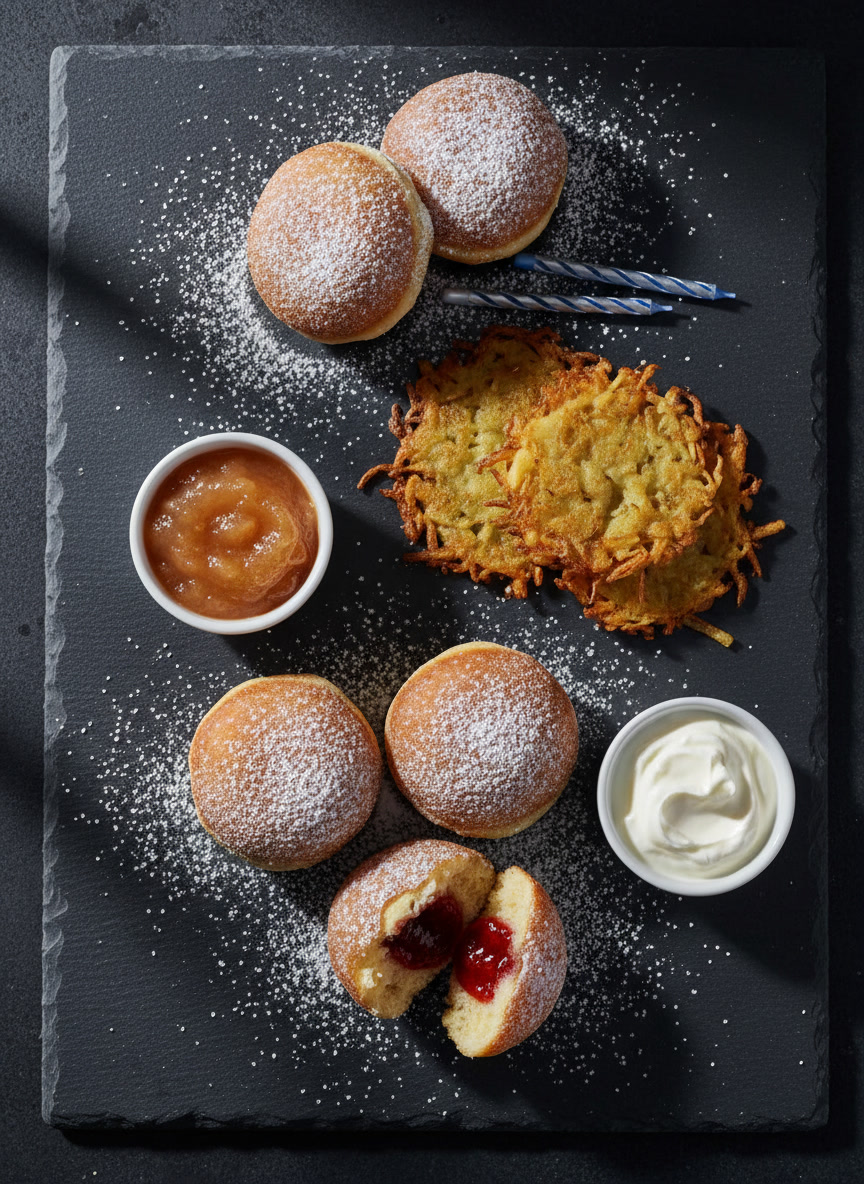
The Best Card of the Six, and the Only One With Nothing to Count or Spell
This is what the model does when you stop asking it to be literate or numerate. Sufganiyot dusted heavily enough that the sugar has drifted across the slate, one split open with the red jam glistening at the break, crisp latkes with genuinely convincing shredded-potato edges, apple sauce and sour cream in their bowls, two blue and white candles laid across the corner. The textures are editorial-magazine standard and there is not a single artefact to explain away. That is not a coincidence — there is no text in the frame and no quantity that has to be exact, so the two things this model reliably breaks were never in play. One small liberty: a stack of latkes was requested and two lying flat and overlapping arrived, which is a difference nobody will ever notice. The practical lesson is to pick the subject that plays to the strength. Food, candlelight and texture are safe. Letters and counts are not.
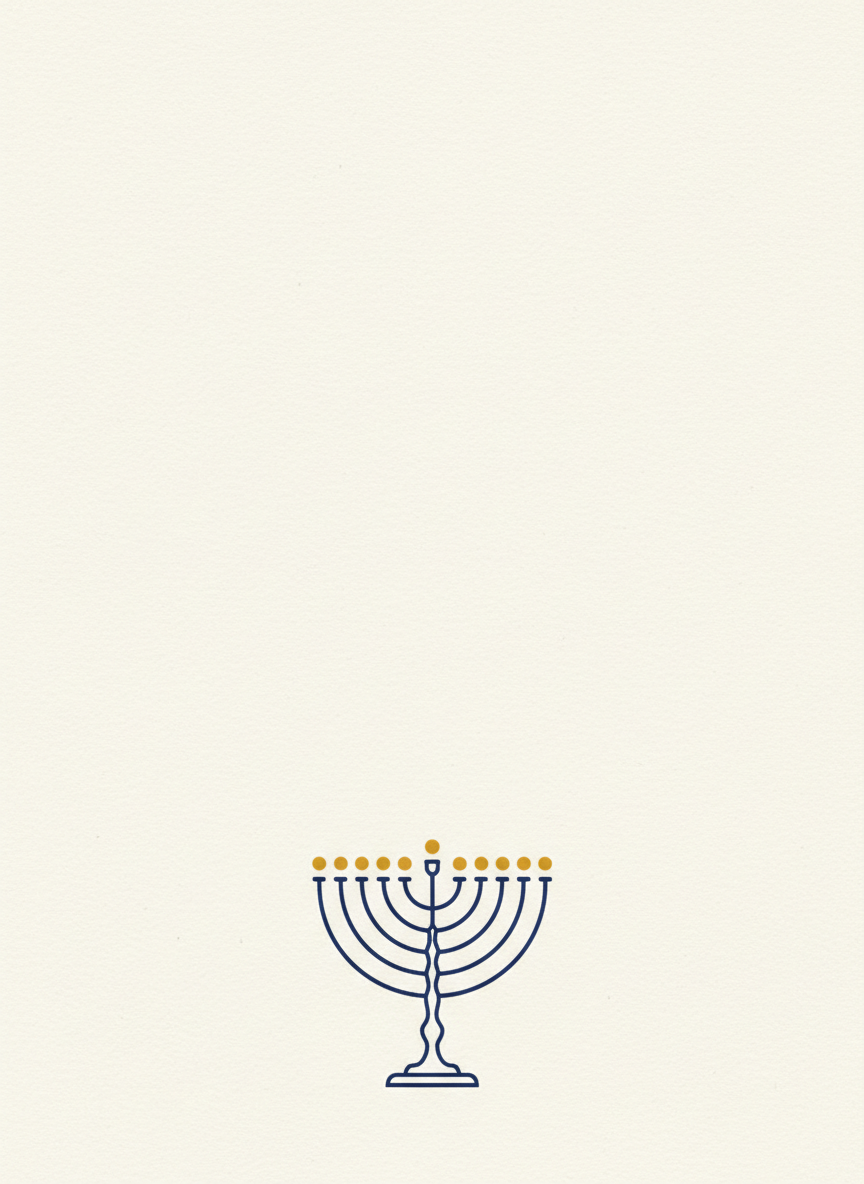
Nine Again, and a Card That Is Ninety Percent Empty Paper
Count the dots: four, one, four, nine, correct. Count the branches: nine, correct. That is two out of three menorahs on this page with the right number, and it matters that the two successes are the ones where the menorah was the whole subject, while the failure was the one where the menorah was a decoration sitting underneath a block of lettering. When the model has one thing to get right it has a decent chance of getting it right. The restraint here is real — the upper two thirds are completely empty bone white with a believable paper grain, exactly as asked — and this is the preset to reach for if you want to letterpress the greeting yourself in a typeface you choose. Two honest notes. The drawing is an outlined silhouette rather than the single continuous monoline that was requested, and the emblem occupies a very small patch of a large sheet, so if you want it larger you are cropping in and throwing away resolution rather than generating it bigger.
The Hebrew Will Be Wrong, and You Will Not Be Able to See That It Is Wrong
This is the single most important thing on the page. Two images in the gallery above asked for Hebrew and both came back wrong. The greeting card asked for חג חנוכה שמח, three words, and returned פה מבחשת, two words that are not the greeting. The dreidel set named nun, gimel, hey, shin in order and returned hey, pe, mem, shin — one correct letter out of four, with the Israeli pe and the diaspora shin welded onto the same set and the opening two letters simply gone. What makes this different from the usual complaint about AI and text is that there is no tell. Every glyph in both images is a genuine, correctly formed, beautifully drawn Hebrew character, kerned properly and running right to left. There is no mangled letterform to catch your eye, no smear, nothing that reads as a mistake. A person who does not read Hebrew will look at gold foil lettering on navy and reasonably assume it says what they asked for. So do not send Hebrew you cannot read. Either generate the card with no lettering at all — which is what every preset on this page is written to do — and set the type yourself afterwards in any app with a text box, or have someone who reads Hebrew look at the image at full size before a single copy goes out. English in plain capitals is meaningfully safer, but it still earns a letter-by-letter read.
Nine Is a Coin Flip, and Nine Is Not a Cosmetic Detail
A hanukkiah has nine branches — eight for the eight nights and a ninth shamash, held apart from the other eight, used to light them. The seven-branch menorah that appears in synagogues and on the emblem of the State of Israel is a different object entirely and is simply wrong on a Hanukkah card. Across the three menorahs in the gallery above, two came back with exactly nine and one came back with eleven. The photographic brass menorah is perfect: four, four, one raised shamash, all nine lit, the outer eight level with one another. The minimal line card is perfect too: nine branches, nine flames. The gold line drawing under the Hebrew greeting has five branches on each side of the centre, which is eleven. The pattern in that is worth knowing. The two correct ones are the images where the menorah was the entire subject; the wrong one is the image where the menorah was a decorative element sitting underneath a block of lettering the model was also struggling with. Give it one thing to get right and it has a good chance. The same inability to count shows up everywhere else too — the gift wrap pattern was asked for twenty five stars in five rows of five and produced forty two in six rows of seven — but on a star pattern the miscount is harmless and on a menorah it is not. Count the branches. Count the flames. Every time.
It Has Seen Hanukkah. It Does Not Know Anything About Hanukkah.
The model has clearly absorbed an enormous number of Hanukkah photographs and reproduces their look with real fluency — the brass, the candlelight falloff, the icing sugar, the blue and silver, the worn maple of a dreidel. What it has not absorbed is that any of it means anything. It does not know that the shamash is not one of the eight, that candles are placed right to left and lit left to right, that the four letters on a dreidel are an acronym for a sentence rather than a decorative pattern, or that swapping one of them changes which country the dreidel is from. It matched those things visually where it matched them at all, and where visual pattern and religious meaning came apart, meaning lost every time. Practically, that means two things. First, use it for the parts of a card that really are just pictures — light, food, colour, texture, a family at a table — because on those it is genuinely excellent, and the sufganiyot flat lay in the gallery is a better photograph than most stock. Second, treat every religious detail in the output as a draft for a person to check, not as information. This page makes pictures. It does not know halacha and it should not be asked to.
How the AI Hanukkah Card Generator Works
Three steps, and the second and third are the ones people skip
Pick a Style and Describe the Card
Choose one of the six presets, then add your own details in the box — the colours, the family, the dog, the menorah you actually own. Name colours as well as objects.
Count the Branches and the Flames
The step nobody does. Nine branches, eight plus a raised shamash. If you got eleven or seven, generate again — it costs fifteen seconds and it is the error people notice.
Add the Greeting Yourself
Take the clean card into any app with a text box and type the words. Correct Hebrew, correct English, correct family names, and a typeface you chose deliberately.
Card, Invitation or Wrapping Paper — Picking the Right Page
This page is built for the Hanukkah card itself. For the other winter holidays the site has dedicated pages with their own presets and their own honest failure notes: the AI Christmas card generator, the AI Diwali card generator and the AI Thanksgiving card generator. For a birthday, a new baby or a thank you, the AI greeting card maker covers the general case. If you want the star grid as actual tiling gift wrap, the AI pattern generator is built for seamless repeats, and for a party on the first night the AI invitation generator handles the invitation layout. The sufganiyot flat lay came out of the same model that powers the AI food photography generator, and any white border the model adds comes off with the AI image cropper.
Why Use This Hanukkah Card Maker
Because the card shop stocks three designs and two of them have a snowman on
Six Hanukkah Card Styles
Navy and gold elegance, a photographed brass menorah, dreidels and gelt, a bright cartoon for children, a sufganiyot and latkes flat lay, and a very minimal modern card.
Built to Leave Room for Your Words
Every preset asks for a clean, uncluttered area and no lettering in the image, because the gallery above shows what happens when this model is asked to write Hebrew.
Honest About the Candle Count
Three menorahs, two with nine branches and one with eleven, shown at full size instead of discovered by a relative on a card that is already printed.
Cards, Wrap, Tags and Invitations
The same styles work for a card, a repeating gift wrap pattern, a party invitation for the first night, or a header for the family group chat.
As Many Versions As You Like
A designer charges per card and a card shop sells you the same three designs as everybody else. Generate twenty, keep the one where the candles are right.
Free, No Sign Up, No Watermark
About fifteen seconds a card, no account, no queue, nothing stamped across the corner. Hanukkah 2026 begins at sundown on 4 December, so there is time to iterate.
Who Uses It
People sending eight nights of cards, and people who left it until the fourth
Families Sending Cards
A card that looks like your family rather than like a card shop: your menorah, your tablecloth, your dog under the table. Generate it clean, then type the names yourself so every one of them is spelled right.
Teachers and Community Groups
Classroom decorations, synagogue newsletters, JCC flyers and school displays. The Kids Cartoon preset is deliberately the friendliest of the six — and please count the branches before it goes on a wall in front of children.
Small Shops and Makers
Product backdrops, holiday email headers, market stall signage and gift wrap. Nothing is watermarked and everything is yours to sell, which makes eight nights of social posts cost an afternoon rather than a design budget.
Interfaith and Mixed Households
Cards that put a menorah and a tree in the same frame are almost impossible to buy and easy to describe. Pair this page with the AI Christmas card generator and make one of each for the two halves of the address book.
AI Hanukkah Card Generator FAQ
Hebrew, candle counts, printing, and what you may do with the result
Free AI Hanukkah Card Generator — Menorahs, Dreidels and Eight Nights of Cards
Hanukkah 2026 begins at sundown on 4 December, which is eight nights of candles, eight nights of photographs in the family group chat, and one card that has to go out to everybody before the first of them. The shops are not much help: a rack that is nine tenths Christmas will offer you three Hanukkah designs, two of them blue snowflakes that could be about anything, and none of them will look like your family or your menorah. An ai hanukkah card generator changes that arithmetic. Describe the card — your brass hanukkiah on the blue tablecloth, the children, the dog, the doughnuts — and fifteen seconds later you have a 3:4 portrait card, with no account, no queue and nothing stamped across the corner.
The six presets on this Hanukkah card maker cover the range the holiday actually gets photographed in. Navy and Gold is the formal one, a slim gold menorah low on deep midnight blue with the whole top half left clear for your greeting. Photographic Menorah is a real brass hanukkiah on dark wood with candlelight as the only light source, and it is the preset that produced the best single image in the gallery above. Dreidels and Gelt is the warm daylight flat lay, linen and maple and foil-wrapped chocolate. Kids Cartoon is flat, bright and friendly, built for classrooms and for children who will put it on the fridge. Sufganiyot and Latkes is unapologetic food photography, and it is worth saying that it beats most stock. Minimal Modern is one small navy line drawing at the bottom of an otherwise empty bone white sheet, for people who want to set the type themselves and want room to do it.
Two limits, demonstrated in the gallery rather than asserted, and between them they decide how you should use this page. The first is Hebrew. This model draws Hebrew letterforms beautifully and cannot spell a word of it. Asked for the standard greeting חג חנוכה שמח it returned פה מבחשת; asked for the four dreidel letters in order it returned one of the four correctly. Every character it drew was a real, well-formed Hebrew letter, which is precisely why this is worse than the usual AI text problem — there is no visual tell, so a sender who does not read Hebrew has no way to catch it. The second is counting. A hanukkiah has nine branches, eight plus the shamash, and that number is religious rather than decorative. Of three menorahs generated here, two had nine and one had eleven. A gift wrap grid asked for twenty five stars produced forty two. Neither of these is a reason not to use the tool; both are reasons to spend ten seconds on the result before you commit it to print.
The working method that comes out of all this is simple, and every preset on this page has been written to support it: generate the picture here with no lettering in it, count the branches, then add the words yourself in any app that will put a text box over an image. That gives you correct Hebrew, correct English, family names spelled the way your family spells them, and a typeface you actually chose. For the rest of the season the neighbouring tools finish the job — the other winter holidays at the AI Christmas card generator and the AI Diwali card generator, everyday cards at the AI greeting card maker, seamless gift wrap at the AI pattern generator, the party invitation at the AI invitation generator, doughnuts and latkes at the AI food photography generator, packaging and labels at the AI sticker generator, and any unwanted white border trimmed at the AI image cropper. Everything here is free to try, nothing is watermarked, cards come back at 3:4 portrait, and paid plans start at $2.99. Scroll back up and make one — then count the candles.