AI Snow Globe Generator
The Glass Is Drawn, Not Simulated
Upload a photo and get back a snow globe with your pet, your family or yourself sealed under the dome — mahogany Christmas classic, white keepsake, gold glitter at midnight, antique brass music box. This ai snow globe generator is free, needs no account and adds no watermark. It also, as the gallery below shows at full size, paints the glass instead of obeying it.
Try the AI Snow Globe Generator — Free
Upload a photo, pick a globe, and check the background through the glass when it lands
AI Snow Globe Generator
Upload a photo of a pet, a person or a couple, then choose one of the six globe styles below. Each style is a complete instruction on its own, so there is nothing to type — pick one and generate. Three things to know before you do. Your subject is repainted as a small resin figure rather than composited under glass, so faces come back as a close likeness and fine detail drifts. All six styles deliberately produce a blank base, because you will get a better result adding a name yourself than trusting it to a prompt you cannot edit. And one subject beats four every time: the more hands there are in your photo, the more hands the model has to invent inside the dome.
Upload a pet, person or couple, pick a globe style, and generate — no typing needed
Renders at 3:4 portrait, which suits a tall object and prints well at 5x7. There is no ratio picker on this page, so the square example in the gallery below cannot be produced from here — for that, or to trim a border the model has added, use the AI image cropper or pick a ratio on the home page generator.
AI Snow Globe Generator Examples
Six globes exactly as they came back — check the glass, the hands and the count
Three Singers Asked For, Three Singers Delivered. And a Suitcase Nobody Ordered.
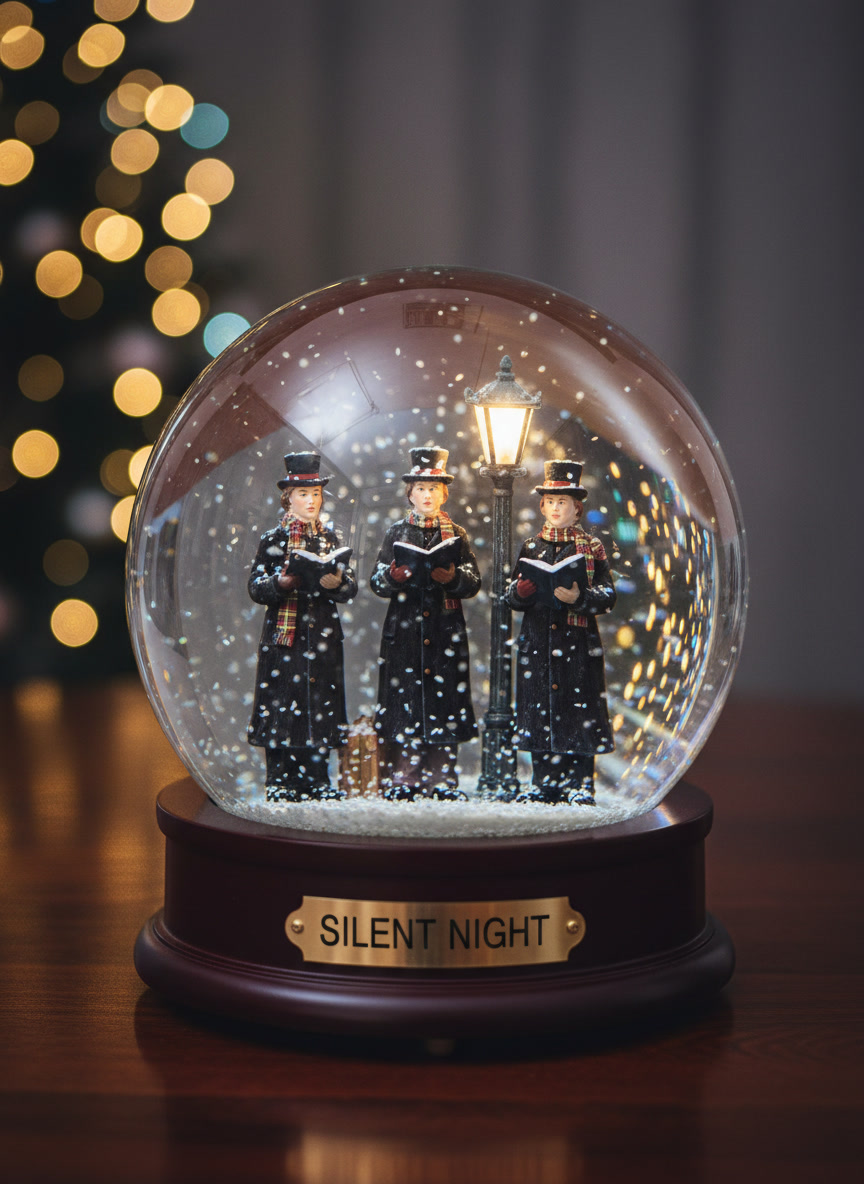
Start with the good news, because there is more of it on this page than usual. The prompt asked for exactly three Victorian carol singers beside one cast iron street lamp, and three is precisely what arrived — three figures, three songbooks, one lamp. The brass plaque on the base reads SILENT NIGHT in clean even serif capitals with nothing misspelled. Both of the things this model normally fails at went right. Now look at the snow between the first and second singer. There is a small brown wooden crate or suitcase sitting there that was never asked for and has no business in the scene, the kind of prop the model adds to fill a gap it does not like the look of. Look at the hands too: every songbook is held by a red mitten with no separated fingers in it, and all three faces are the same young face painted three times. The resin figures, the snow on the shoulders and the warm bokeh behind are genuinely beautiful.
The Glass Is a Drawing of Glass. Watch What Happens to the Tree Behind It.
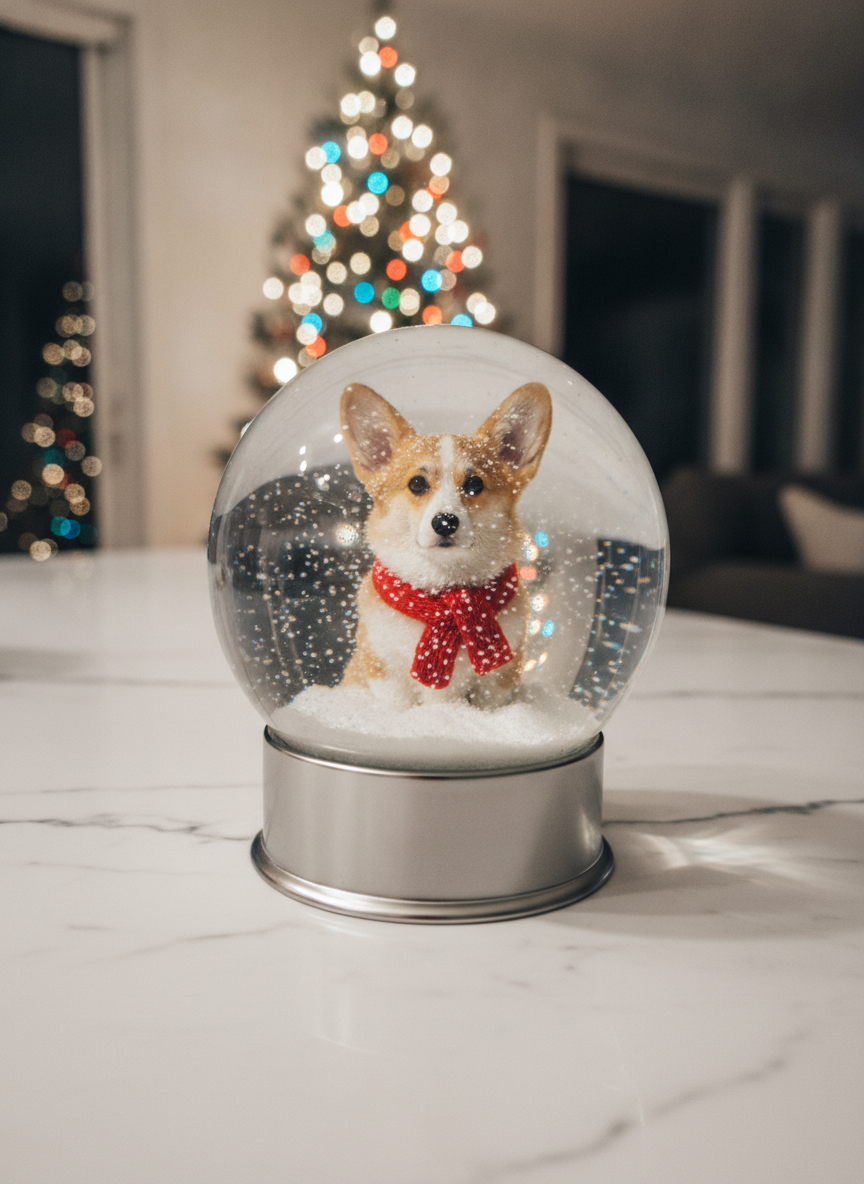
This is the failure the whole page is built on, and once you have seen it you will see it in every AI snow globe on the internet. There is a large lit Christmas tree directly behind this globe. A glass sphere full of water is a powerful lens — it would take that tree and throw it back at you magnified and upside down, filling the dome. Instead the tree simply stops where the globe begins. What you get inside the dome is a separate, shrunken, tidied-up version of the room, with a few small coloured dots standing in for hundreds of lights. The model made the background smaller through the glass when real glass would have made it bigger. The corgi gets the same treatment: pin sharp, full size, with no distortion, no magnification and no glass reflection anywhere across its face, as though it were a sticker on a circle rather than an object under a dome. The dog itself is superb — markings, fur, the knit of the scarf, all excellent.
THE MILLER FAMILY 2026, Spelled Perfectly. Now Count the Hands.
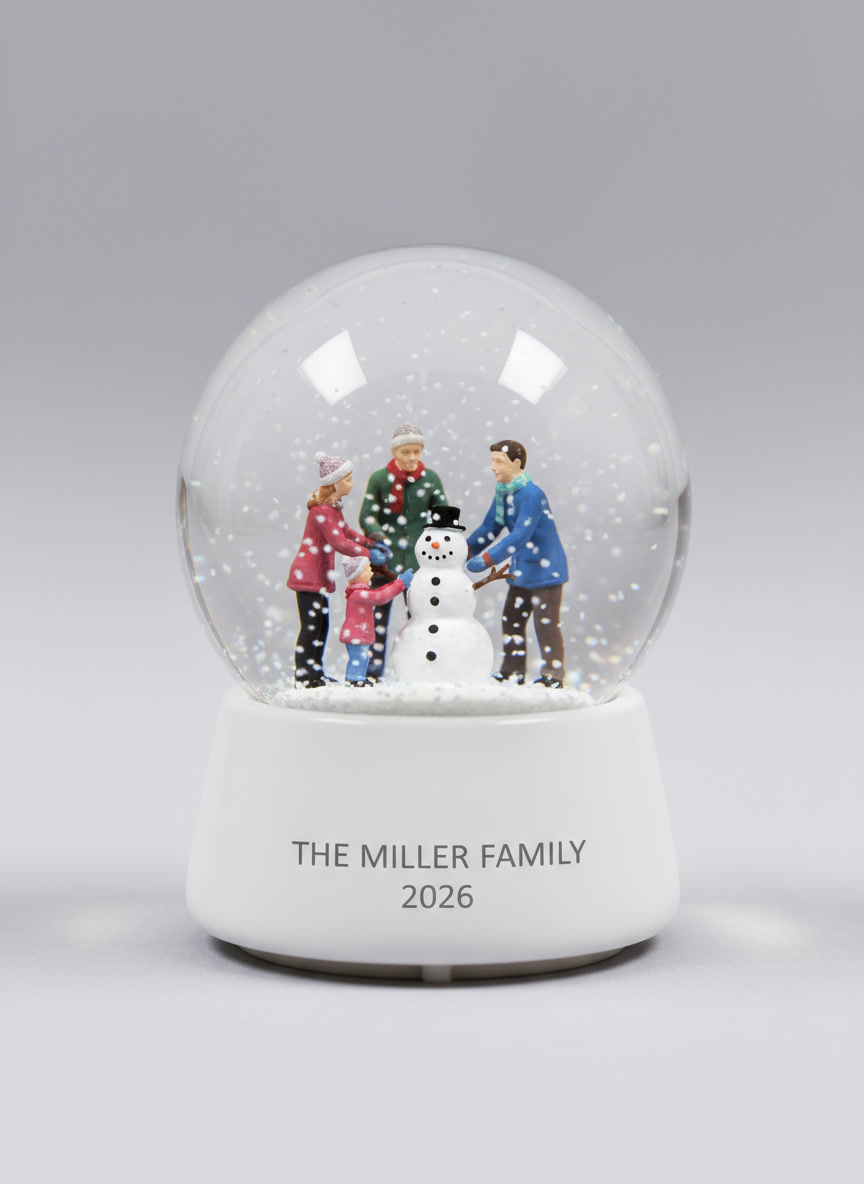
The text is flawless again: THE MILLER FAMILY on the first line, 2026 on the second, centred, correctly spelled, correctly stacked. The headcount is right as well — four people were asked for and four arrived, two adults and two children, plus exactly one snowman with a top hat and a carrot. That is two prompts in a row where the counting and the lettering both landed. Then crop into the middle of the scene, where four people are supposedly touching one snowman, and it falls apart completely. The adult in the green coat has no arms at all; the coat has no sleeves coming out of it. Floating in the gap in front of him are a blue mitten, a second blue mitten, a brown stick and a dark shapeless blob, none of which connects to anybody. The snowman’s own twig arm on the right is attached to nothing and has a second twig growing out of it. The woman in red reaches toward the snowman and her hand ends as a navy smudge.
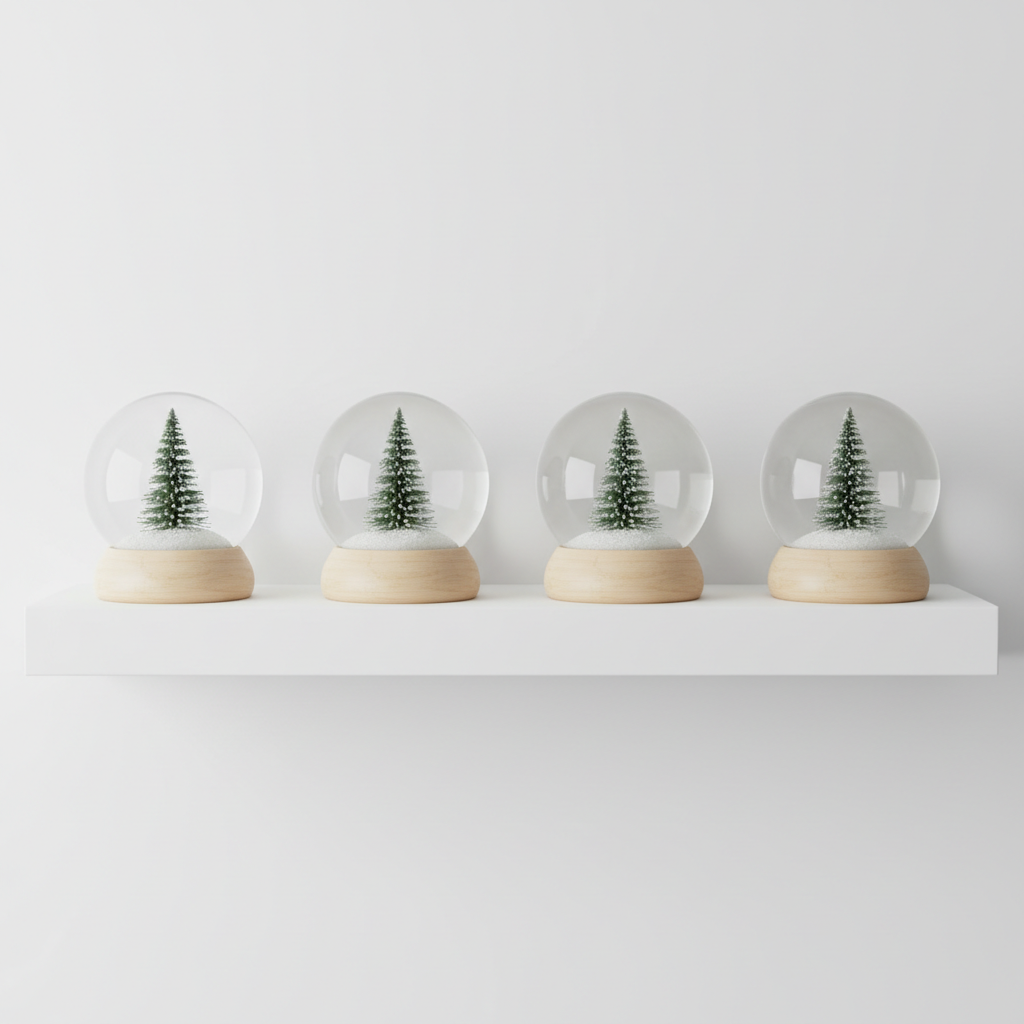
Four Globes Asked to Be Identical. Four Different Trees Arrived.
The count is right again — four globes, one row, evenly spaced on one shelf. The prompt then asked for something harder: that all four be absolutely identical, same dome, same birch base, same single fir tree inside each. Put the first and the fourth side by side and they are plainly different objects. The tree in the first globe is tall, slender and sits dead centre with a clean dark green needle profile. The tree in the fourth is shorter, noticeably broader, heavily flocked with white, and sits well right of centre against the side of the dome rather than in the middle of it. The two globes in between are two more variations again, each with its own snow drift shape. This is the repetition failure and it is worth separating from the counting failure: the model can produce the right number of things and still be unable to produce the same thing twice. If you want a matching set — one globe per family member, a row for a shop listing — generate them one at a time and accept that they will be cousins rather than siblings.
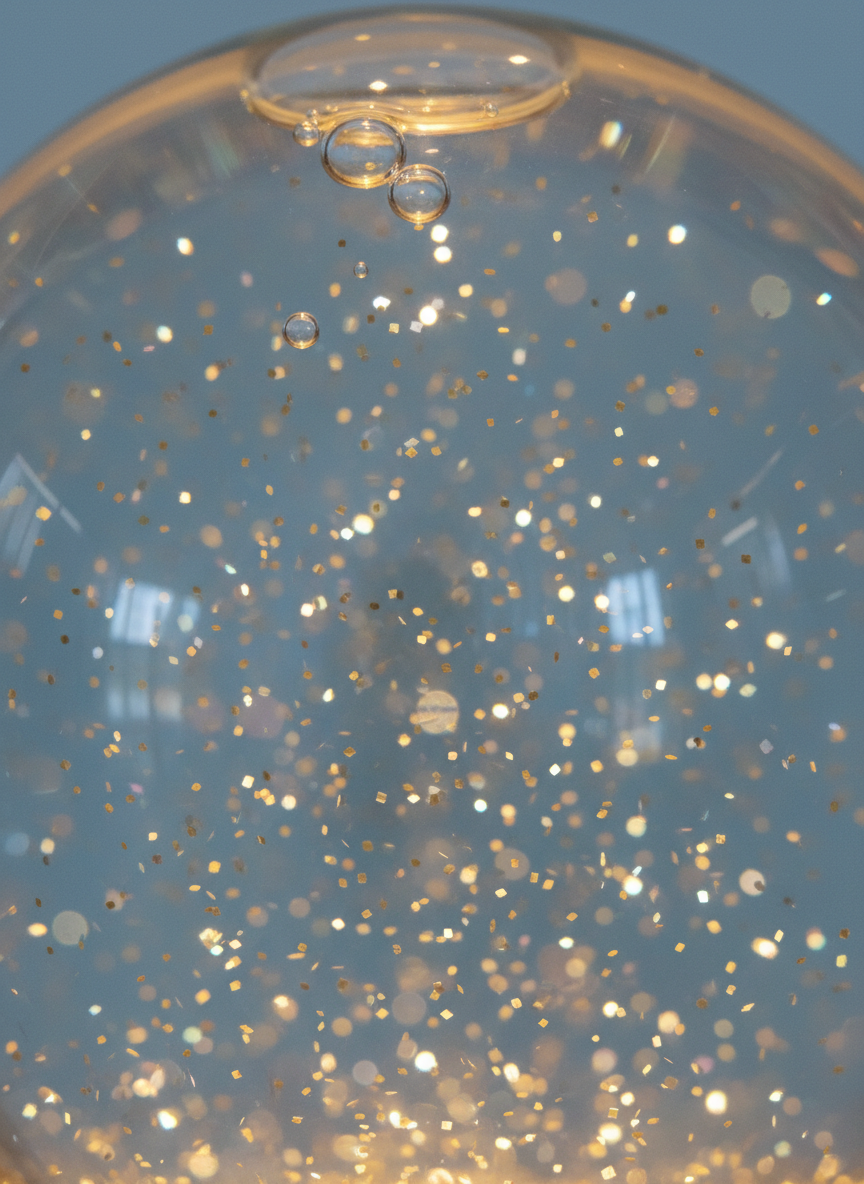
And Here Is the Same Model Rendering Glass Beautifully
This is the one to look at before you decide the tool is not worth using, because it is genuinely superb and it sharpens the point made above. Asked for a macro of the inside of a globe with glitter suspended in the water and a few bubbles clinging to the top of the dome, it delivered exactly that: gold flakes in mixed square and hexagonal cuts, the way real craft glitter is actually shaped, each one catching its own pinpoint of light; a flat air pocket sitting under the crown of the dome with three smaller bubbles beneath it, each with a correct curved meniscus; the thick glass at the frame edge bending and stretching what passes through it; and a believable falloff from sharp near flakes to soft far ones. So the model is not incapable of glass. It renders glass correctly when the glass is the subject of the picture, and abandons the optics the moment the glass has a room behind it that has to come through. Knowing which of those two situations you are in tells you how carefully to look.
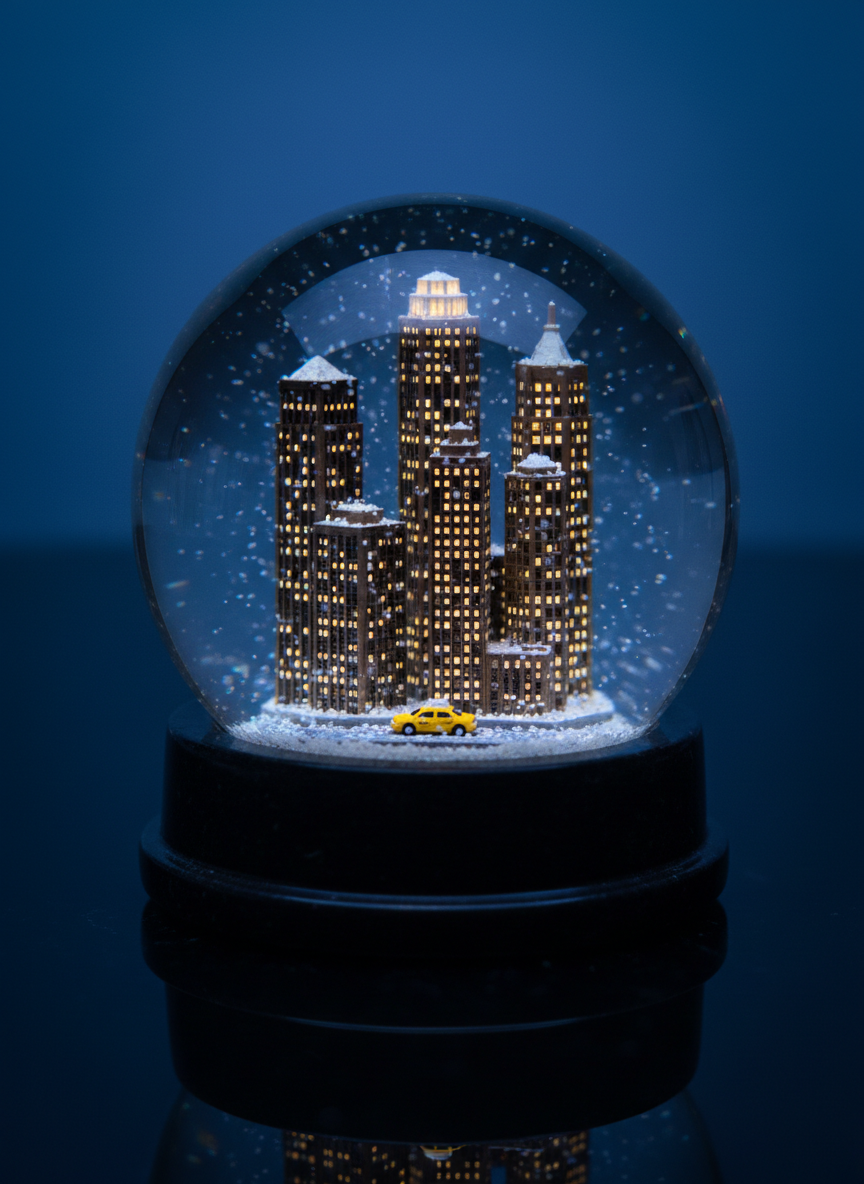
Five Skyscrapers Were Asked For. There Are At Least Eight.
Here is where the counting run ends. The prompt named the number twice — exactly five skyscrapers of different heights, and then count the towers carefully, five buildings, no more and no fewer. Count them in the crop and you can separate at least eight distinct towers: two at the left with snow-capped roofs, a wide flat-topped block in front of them, the tall central tower with the lit crown, a shorter flat-capped tower in front of that, the right hand tower with the obelisk spire, another behind it, and a low snow-capped block at the bottom right. Three, four and five were the boundary: threes and fours came back right all day, and the first prompt that asked for five got eight. The single yellow taxi is correct, and then it is in the wrong place — it was asked to sit on a street running between the towers and it is parked on the white snow rim at the very front of the scene instead, which is the same spelling-right-placement-wrong pattern the lettering shows. The snow settled on the individual rooftops is lovely.
These six were generated from written descriptions rather than from an uploaded photo, so that each globe could be specified precisely enough to test. The tool above starts from your picture instead — same model, same styles, same failure modes.
The Glass Is Painted, Not Obeyed — and the Background Is How You Catch It
This is the single most important thing on the page, and it is the reason AI snow globes look subtly fake even when nothing is obviously wrong. A snow globe is a sphere of water, which is a strong converging lens. Whatever sits behind it arrives on your side of the glass magnified and turned upside down, big enough to fill the dome. In the corgi example above there is a large lit Christmas tree directly behind the globe, and the prompt explicitly asked for those lights to be magnified and inverted through the curve. They are not. The tree stops dead where the dome begins, and what appears inside is a separate, smaller, tidier version of the room with a handful of coloured dots standing in for hundreds of bulbs. The model shrank the background where real glass would have enlarged it. The dog gets the same treatment: pin sharp, full size, no distortion, no magnification and not one glass reflection across its face. What you are looking at is a circle with a scene drawn behind it and a highlight painted on the rim. The check takes two seconds: pick one thing behind the globe and follow it into the dome. If it arrives the same size and the right way up, the glass is decoration.
It Will Get the Headcount Right and Then Lose the Arms
The family keepsake asked for four people and one snowman, and four people and one snowman is exactly what arrived. Two adults, two children, a top hat and a carrot. Then crop into the middle of the globe, where those four are supposedly touching the snowman, and the scene comes apart. The adult in the green coat has no arms at all — the coat has no sleeves emerging from it in either direction. Floating in the gap in front of him are a blue mitten, a second blue mitten, a brown stick and a dark shapeless blob, and not one of them joins onto anybody. The woman in red reaches toward the snowman and her hand terminates in a navy smudge. The snowman’s own twig arm on the right attaches to nothing and sprouts a second twig from halfway along it. Even the carol singers, where the figures are clean and correctly counted, hold their songbooks in red mittens with no separated fingers anywhere. The practical rule is that a correct headcount is not a correct body count. Follow every arm from a shoulder to a hand, and count the hands touching anything. Then upload fewer people: one subject is dramatically more reliable than four.
It Counts Correctly Up to Four, Spells Correctly Throughout, and Cannot Repeat Itself
Most pages on this site exist to warn you that this model cannot count and cannot spell. On snow globes it spelled everything correctly and counted correctly right up until the number got to five. Three carol singers were asked for and three arrived, beside exactly one street lamp. Four family members plus one snowman were asked for and four plus one arrived. Four globes on a shelf were asked for and four arrived. Then the first prompt that asked for five skyscrapers returned at least eight, with the number stated twice in the prompt. Treat four as the ceiling. The lettering, by contrast, never missed: SILENT NIGHT on a brass plaque and THE MILLER FAMILY above 2026 on a ceramic base, both correctly spelled, cleanly set and properly centred, with no doubled letters and no invented accents. And a third thing, separate from both: it cannot repeat itself. Four globes asked to be absolutely identical came back with four visibly different trees — different heights, different widths, different flocking, one of them sitting off-centre against the side of its dome. Getting the number right and getting the copies right are two different abilities, and this model has only the first. If you want a matching set, make them one at a time and expect cousins rather than siblings.
It Repaints Your Photograph. It Does Not Put It Under Glass.
Everything above follows from one fact, so it is worth stating plainly. When you upload a picture, the model does not shrink your subject and composite it inside a rendered dome. It reads your photograph and paints a new picture of a resin figure that resembles it. Faces come back as a close likeness — brow, hairline, colouring and the shape of a smile survive well — while hands, clothing detail, jewellery and everything around the figure are invented from scratch. That is why an adult can arrive with no arms, why a crate turns up in the snow, and why the glass behaves like a drawing. Two consequences that matter. Give it as little to guess at as possible: one clearly lit subject, facing the camera, rather than a group. And say what the result is when you send it. This is an illustration of a snow globe, not a photograph of one. It will make a lovely card front, a wallpaper or a gift print of the dog; it will not give you a product mockup a factory can work from, or a picture of an object that exists on anybody’s shelf.
How the AI Snow Globe Generator Works
Three steps, and the third is the one everybody skips
Upload One Clear Subject
One pet, one person or a couple, well lit and facing the camera. The fewer hands there are in the picture, the fewer hands the model has to invent inside the dome.
Pick a Globe Style
Six presets, from the mahogany Christmas classic to the brass music box. Each is a complete instruction on its own — there is no text box on this page to add to it.
Check the Glass, Then the Hands
Follow one thing from behind the globe to inside it, and follow every arm from a shoulder to a hand. Those two checks catch nearly everything. Generating again costs fifteen seconds.
Globe, Figure or Card — Picking the Right Page
This page seals your subject inside a glass dome. If what you want is your subject turned into a different kind of collectible, the AI plushie generator makes it a soft toy and the AI action figure generator boxes it up in blister packaging. For a card design rather than an object, use the AI Christmas card generator or the AI greeting card maker. The rest of the season has its own pages — a photograph with Santa in it at the AI Santa photo generator, the tree and the mantel at the AI Christmas decoration generator, the jumper at the AI ugly Christmas sweater generator, and the dog on its own at the AI pet portrait generator. If the photo you want to use is old or damaged, run it through AI photo restoration first, and trim any border the model adds with the AI image cropper.
Why Use This Snow Globe Maker
Because a custom snow globe costs sixty pounds and takes three weeks
Six Globe Styles
The classic Christmas dome on mahogany, the studio keepsake with a blank engravable base, the pet in a scarf, gold glitter at midnight, a snowy village and an antique brass music box.
Honest About the Glass
The dome is painted, not simulated. This page shows you the exact moment the illusion breaks — a Christmas tree that should come through the glass magnified and inverted, and does neither.
Honest About Hands
In the four-person test one adult came back with no arms and the middle of the scene filled with loose mittens. Shown at full size and cropped, rather than left for you to find after printing.
Counting Holds Up to Four
Three singers, four family members, four globes on a shelf — all correct. Then five skyscrapers came back as at least eight. The boundary sits around four, which is useful to know before you ask for six of anything.
Pets Come Back Best
Fur, markings and knitted wool are the three things this model is strongest at, so a single animal under the dome is the most convincing thing it will make for you. Start there.
Free, No Sign Up, No Watermark
About fifteen seconds an image, no account, no queue and nothing stamped across the corner. Generate a dozen and keep the one where the hands behave.
Who Uses It
People sending cards, people who miss a pet, and shops who need a season of posts
Pet Owners
The single most reliable thing this tool makes. One animal, one scarf, one dome — fur and knitted wool are exactly what the model is best at, and with one subject there are no spare hands for it to invent. The corgi in the gallery above took one attempt.
Card and Keepsake Makers
A 3:4 globe sits straight on a folded card or a 5x7 print. Use the Studio Keepsake style, which deliberately leaves a clean empty band of white ceramic on the base, then set the family name and the year there yourself.
Couples and Families
Two people under one dome works well and four is where it starts inventing limbs. If you want the whole family in there, generate it a few times and check every arm before you commit — or make one globe each and put them side by side.
Shops and Social Accounts
A season’s worth of festive posts from photographs you already own, in about fifteen seconds each. Label them as illustrations rather than product shots, because the glass in them is painted and anyone who looks at the background will see it.
AI Snow Globe Generator FAQ
Glass, likeness, counting, engraved names, printing and what it costs
Free AI Snow Globe Generator — Your Photo Under Glass in Fifteen Seconds
A custom snow globe with your own dog inside it is a charming object and an expensive, slow one: sixty pounds or more, three weeks in the post, and a figure sculpted by somebody who has never met your dog. An ai snow globe generator changes that arithmetic entirely. Upload a photograph you already have, choose one of six globe styles, and about fifteen seconds later you have a 3:4 image of that subject repainted as a resin miniature under a glass dome, with snow suspended in the water around it. No account, no queue, no watermark, and as many attempts as you like until one of them looks right.
The six styles on this snow globe maker cover the versions people actually want. Classic Christmas is the traditional one, mahogany base and a street lamp with a tree glowing somewhere behind. Studio Keepsake is the clean product shot against grey, with a deliberately blank white ceramic base so you can add a name and a year yourself. Pet in a Scarf is the single animal on a marble counter, which is far and away the most reliable result this tool produces. Gold Glitter Midnight swaps snow for champagne glitter for New Year. Winter Village surrounds your subject with tiny lit cottages. Brass Music Box puts the whole thing on an ornate antique base under warm lamplight.
Three findings from the gallery above, all demonstrated rather than asserted. The first, and the one that matters most, is that the glass is drawn rather than simulated. A water-filled sphere is a lens: it magnifies the background and turns it upside down. Given a lit Christmas tree directly behind the globe and an explicit instruction to magnify and invert it, the model shrank it instead and painted a smaller, separate room inside the dome. The second is hands. A four-person scene came back with the correct four people and one adult who had no arms at all, surrounded by loose mittens and sticks attached to nobody. The third is where the numbers stop. Counting held beautifully up to four — three singers, four family members, four globes on a shelf, all exactly right — and then five skyscrapers came back as at least eight. The lettering never failed at all: SILENT NIGHT and THE MILLER FAMILY 2026 were both spelled and set perfectly. But four globes asked to be identical arrived as four different trees, so counting correctly and copying correctly are not the same skill.
The working method that follows is short: upload one clearly lit subject rather than a group, generate the globe with a blank base, then follow one object from behind the glass into the dome and follow every arm from a shoulder to a hand. That gets you the likeness and the texture this model is genuinely good at while keeping you clear of the two things it is not. For neighbouring jobs the other pages finish the work — a soft toy version at the AI plushie generator, a boxed collectible at the AI action figure generator, card designs at the AI Christmas card generator, a photograph with Santa in it at the AI Santa photo generator, the dog on its own at the AI pet portrait generator, a festive desktop at the AI wallpaper generator, and any unwanted border trimmed at the AI image cropper. Everything here is free to try, nothing is watermarked, images come back at 3:4 portrait, and paid plans start at $2.99. Scroll back up and make one — then look at the background through the glass.